A digital twin is a virtual model that replicates a real product or system and runs scenarios using real data that comes from the physical product. Teams generally use these models to observe how the product behaves, test design changes, and study the performance of the real system.
However, a digital twin only shows what is happening with the product. It can’t tell whether the current system behavior is acceptable without structured requirements.
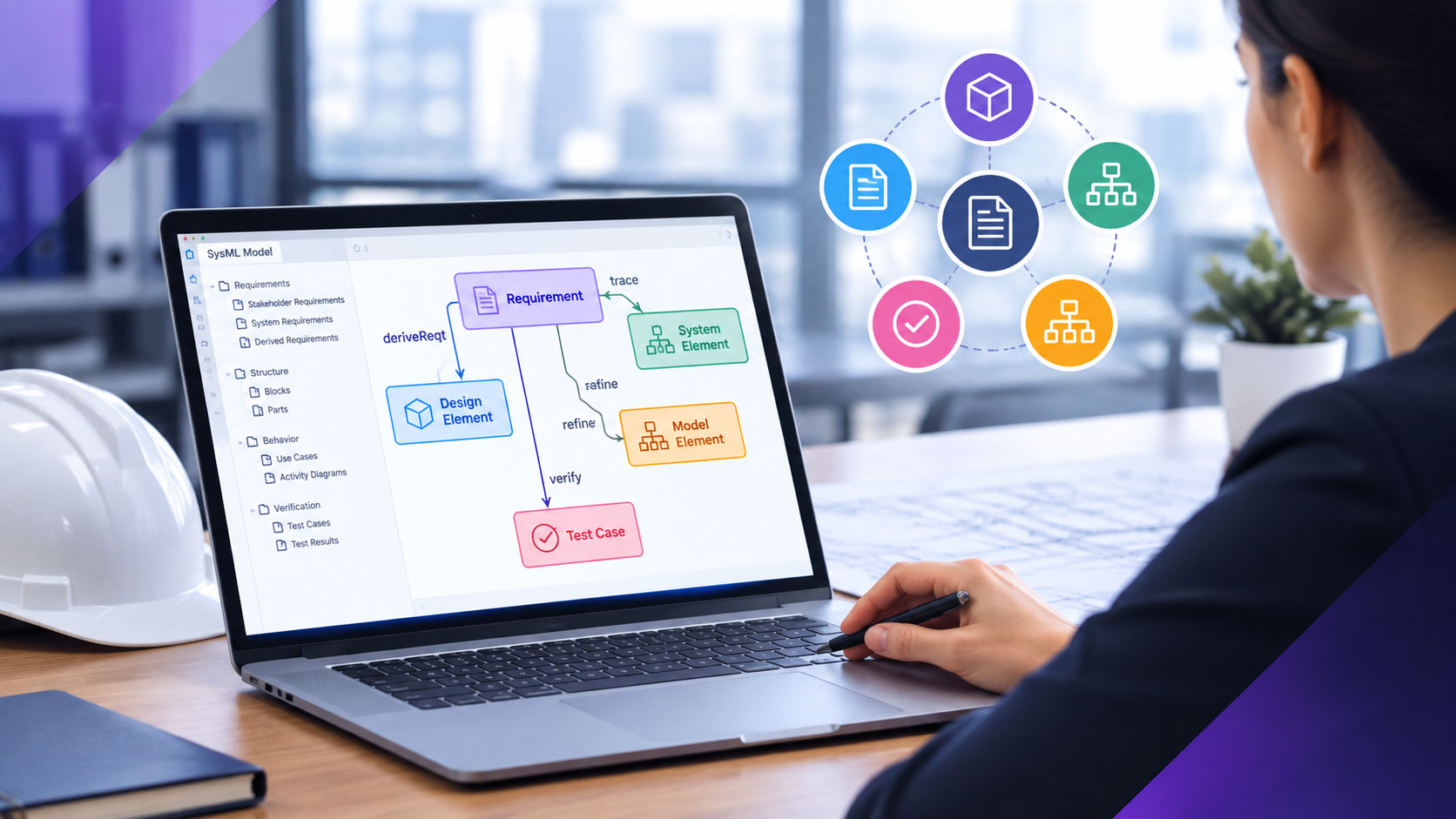
In such situations, requirements management brings a structure that defines the expected behavior of the product, connects engineering models to development workflows, and keeps everyone aligned.
So, let’s understand how a digital twin with requirements management helps in bridging gaps between engineering and DevOps teams.
Digital Twin: Definition and Core Concept
By definition, a digital twin is a virtual replica (developed using software) of a physical product, such as an aircraft, vehicle, or medical device. It doesn’t remain static like a diagram or a design document, but it continuously receives data from the physical system that can be analyzed to understand the product behavior.
So, in real time, engineers can run simulations, analyze performance, and test possible changes before applying them to the real system.
Ejemplo
You can imagine a car company developing a new electric car model. So, they create:
- A real car
- A virtual version of the same car (digital replica) in software.
Sensors from the real car send multiple data points, including battery temperature, motor speed, braking pressure, and energy usage, to the digital twin.
With all data, engineers can test:
- What happens if the battery heats up too much?
- How braking works in the rain
- How the car performs in heavy traffic
This way, engineers can run thousands of tests in software instead of risking real cars.
Also read: What is Digital Thread?
How Digital Twins Are Transforming Product Development
Traditional product development follows a simple loop: Design the system, test it, fix problems, and repeat. This approach works, but it becomes slow and expensive as the system becomes complex.
Digital twin totally alters this. Instead of building physical prototypes, digital twins force teams to study system behavior through a virtual replica of the product that changes with real system data.
Here are some benefits of digital twins:
- Early design validation: Teams can use a digital twin to simulate real-world conditions and catch design errors before they appear.
- Improves operation efficiency: According to a report published on Digital Twin by Capgemini, organizations that use digital twins see an average of 15% improvement in sales and operational efficiency.
- Reduced cost: As product development teams don’t need to build a new prototype to test every scenario, it saves the cost of materials and other required resources.
- Faster iteration cycles: Design changes are tested virtually first, and then teams build prototypes. This saves time required for product development.
Currently, around 42% of executives working in different industries recognize the importance of digital twins, and 59% are already planning to integrate them into their operations by 2028.
Requirements Management in Digital Twin Systems
As discussed previously, a digital twin can simulate the system behavior and analyze the real operating data. However, simulation alone is not enough. Engineers must know:
- What behavior is expected?
- What limits must the system follow?
- What safety rules must be respected?
Those expectations come from predefined requirements. Without that, a digital twin can’t be validated.
Requirements as the Common Language Between Engineering and DevOps
In product development, engineering and DevOps teams speak different languages. Engineers focus on building physical products and simulating digital products. On the other side, DevOps teams focus on developing and managing software to control the physical product.
Consider a simple scenario:
- Engineers simulated the behavior of an electric car battery and confirmed it stays under 50°C after a continuous drive of 300km.
- Months later, DevOps teams change how power is distributed across battery cells. Now, the battery temperature reaches 56°C under certain conditions, and engineering teams don’t have any information about this.
So, when engineering and DevOps teams are not aligned with the same requirements, the product fails.
Here is how requirements management can solve it:
- Engineering teams connect requirements with the digital twin model. They run simulations and link results to requirements and update them.
- Then, DevOps teams connect the same requirements with development tasks and test cases. So, when engineering teams change requirements, it automatically notifies DevOps teams and vice versa.
- Even with full life cycle traceability, both teams can perform impact assessments before making any changes to avoid failure.
This way, when the same requirements are used for simulation and software development, teams validate system behavior using the same reference, which helps to stop the system from drifting from the original requirements.
How Modern Requirements4DevOps Enables Digital Engineering
A digital twin doesn’t just execute two to three scenarios; It runs thousands of scenarios, and teams need to store their results for further analysis and also connect them back to the original requirements. Requirements management platforms like Modern Requirements4DevOps help with that and keep the product lifecycle organized.
Here is how Modern Requirements4DevOps enables digital engineering:
- Centralized requirements repository: The tool stores all your requirements, simulation data, DevOps tasks, etc., within your Azure DevOps. So, different teams don’t need to manage multiple tools, and everything can be accessible in one place.
- End-to-end lifecycle traceability: It allows automatically creating traceability matrices and visualizing how requirements are connected with simulation scenarios, development tasks, and test cases. If there are any missing links, teams can quickly identify and create them.
- Impact analysis for simulation changes: This helps product teams to quickly identify the impact of changes within Azure DevOps.
- Collaboration and governance: Modern Requirements4DevOps offers role-based access and allows multiple teams to work together.
- Support for regulated industries: The tool is built for use in regulated industries, such as aerospace and automotive, and complies with all regulatory standards, including SOC II and 21 CFR Part 11.
So, Modern Requirements4DevOps’s capabilities help teams move beyond isolated simulations and keep them aligned.
The Future of Digital Twins in DevOps and Digital Engineering
Did you know that the digital twin market is projected to reach $384 billion from $33.97 billion in 2026 at a CAGR of 35.40%? From this data, we can say that digital twins are becoming a core part of the modern product development workflow.
In the coming years, digital twins and software delivery won’t run as separate activities. For example, when developers update the control software, the change event can trigger system validation through automatic simulation. In these environments, requirements management will become more important, which will help in connecting engineering and DevOps teams.
Furthermore, AI will strengthen this further. AI can automatically analyze large volumes of simulation results, detect patterns, and give insights to the team that they manually can’t find.
Together, digital twins, requirements traceability, and AI-driven insights will shape how complex products are engineered, validated, and operated throughout their lifecycle.