The Future of AI in Enterprise: How Agentic Systems Are Transforming Work
Artificial Intelligence (AI) is no longer a distant dream; it's...
During product development, requirements never stay fixed for long. The initial draft of the feature or user story seemed clear, but might change after customer feedback, a compliance update, or testing.
The real pains we’ve noticed while talking with our customers are that teams often struggle to manage moving expectations and different versions of the same requirements. When different groups follow different requirement versions, confusion grows fast, and rework becomes common.
Requirements version management solves these challenges by recording the history of all changes, including what was changed, when it was changed, and who made the changes.
Now, let’s understand what requirements versioning is, what problems it fixes, the requirements versioning lifecycle, and why manual version control is not enough.
Requirements versioning is the process of documenting and tracking every change made to product specifications throughout development. Instead of replacing old requirements text, it saves each update as a new state and assigns it a unique identifier (V1.0, V1.2, V2.0, etc.), called a version number.
Version management records and tracks:
It also allows teams to view and restore previous versions if something goes wrong.
With this, teams can know exactly what the requirements were at any stage of development and have access to the latest requirements.
While developing products in regulated industries, whether it could be software for healthcare, vehicles in automotive, or aviation in aerospace, teams must prove that changes were reviewed and approved. Requirements versioning supports this by keeping history, approvals, and trace links ready for audits.
Let’s consider the scenarios below to understand the importance of requirements versioning:
To avoid such types of potential issues, teams must implement a structured requirements version management process that keeps history, ownership, and release alignment under control.
Aspecto | Requirements Version | Requirements Baseline |
|---|---|---|
Objetivo | It keeps a record of how individual work items are changed during the product development life cycle. | A baseline is a fixed and approved snapshot of a set of requirements at a specific milestone. It represents the agreed reference point for all team members. |
Ámbito de aplicación | Each requirement can have its version details. | Covers a complete set of requirements for a release, phase, or approval stage, not just one item. |
When Created | A version is generally created when requirements change. Modern requirements management tools automatically create a new version for every change. Created whenever a change is approved, such as a logic update, constraint addition, or clarification that affects behavior. | Created at formal checkpoints, such as:
|
Change Flexibility | Versions continue to evolve. New versions can be added as long as change control rules are followed. | A baseline is locked. Any modification requires a formal change process and often results in a new baseline. |
Use in Daily Work | Helps in understanding the latest requirements. | Use as an official reference point for what must be built, tested, or delivered in a specific release. |
Compliance Importance | It provides visibility on requirements evolution to audit teams with valid reasons. | Demonstrates that a controlled and approved requirement set existed at a given time, which many standards expect. |
Now, let’s understand how requirements versioning works in real-time product development:
Also read: Version control best practices
Manual version control using spreadsheets or documents may work in small projects, but it collapses as the project grows. In the manual approach, teams create different files for each version, name them like “final_V3_latest”, and share them with team members using emails or chat apps.
The main issue with this approach is that no one knows which file reflects the final and approved requirements. Teams might end up implementing the older version, which introduces rework. Sometimes, it might happen that teams change requirements in a document, while design notes, development tasks, and test cases remain outdated.
Furthermore, teams don’t have any clue about change history when they choose a manual approach for requirements management. Other than that, manual methods also hurt team collaboration. Two team members may edit V 1.0 and create two different copies for V 1.1. Due to this, important updates can be missed.
In short, without automated trace links and version tracking, understanding impact becomes slow and unreliable, especially when compliance evidence is needed.
In the next section, we will see how requirements management tools can help in solving the issues listed above.
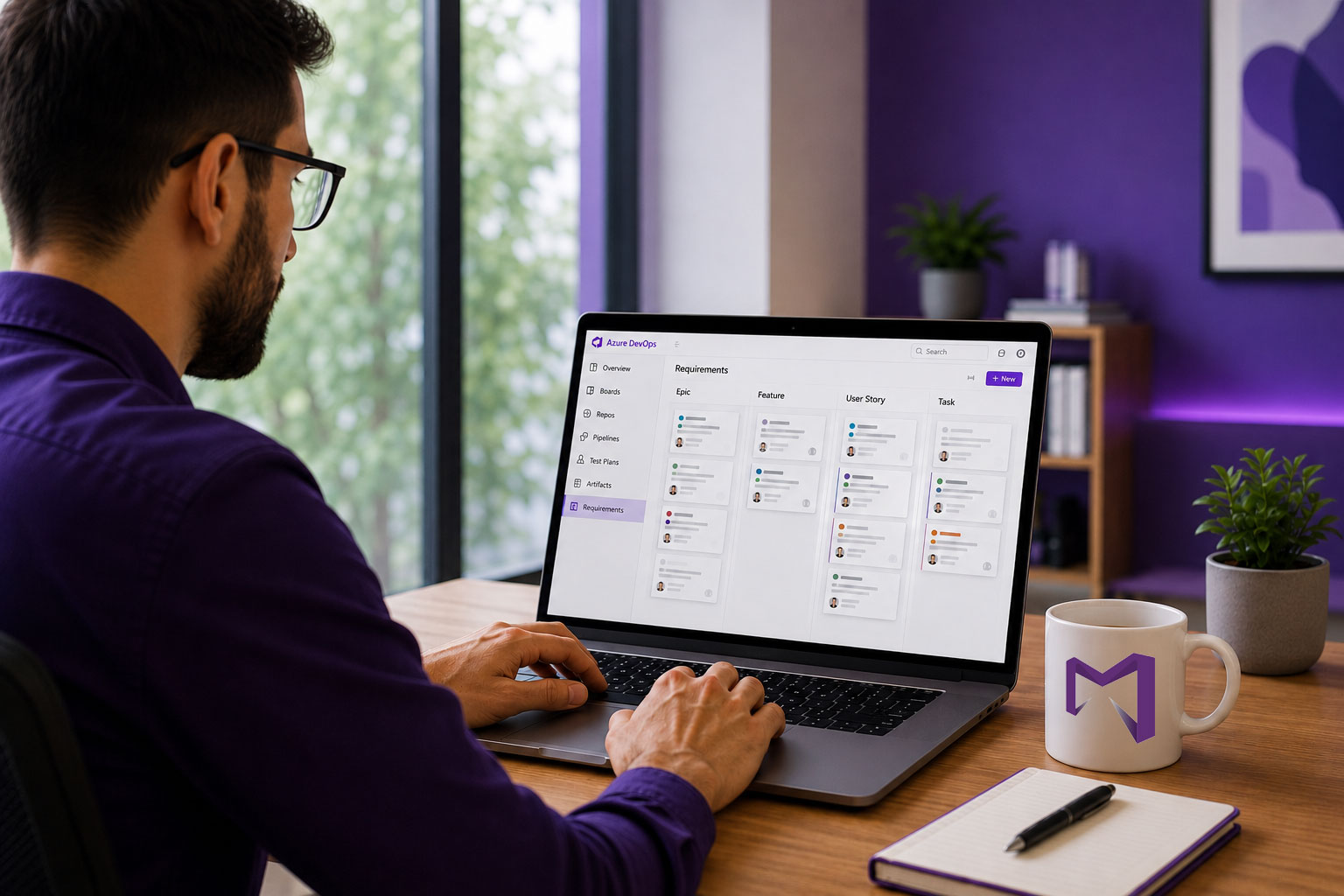
Product development teams need version control in a tool where they manage all requirements. Modern Requirements4DevOps is a requirements management tool within Azure DevOps that works with Azure DevOps and offers versioning and baseline capabilities within your ADO workspace.
Whenever a team member changes any work item within ADO, Modern Requirements4DevOps automatically logs the change with who made it and creates a new version of the requirement. So, teams don’t need to put extra manual efforts into managing different versions.
The best part of using Modern Requirements4DevOps with Azure DevOps is that teams always see the latest version of requirements and compare them with previous versions in a side-by-side view during review. If required, users can also step back by restoring to the previous version. Also, integrated traceability within Modern Requirements4DevOps allows users to see how changes affect related work items and may also update them.
The tool is built to work within regulatory industries. Compliance teams can directly use change or version history while preparing audit reports, as it is important to document changes.
✅ Defina, gestione y realice un seguimiento de los requisitos en Azure DevOps
✅ Colabore sin problemas entre equipos regulados
✅ Empiece GRATIS, sin necesidad de tarjeta de crédito
Artificial Intelligence (AI) is no longer a distant dream; it's...
Check out this detailed guide to know about virtual prototyping,...
Learn more about the importance of SOC 2 compliance, its...