
Passer au contenu

Livre blanc

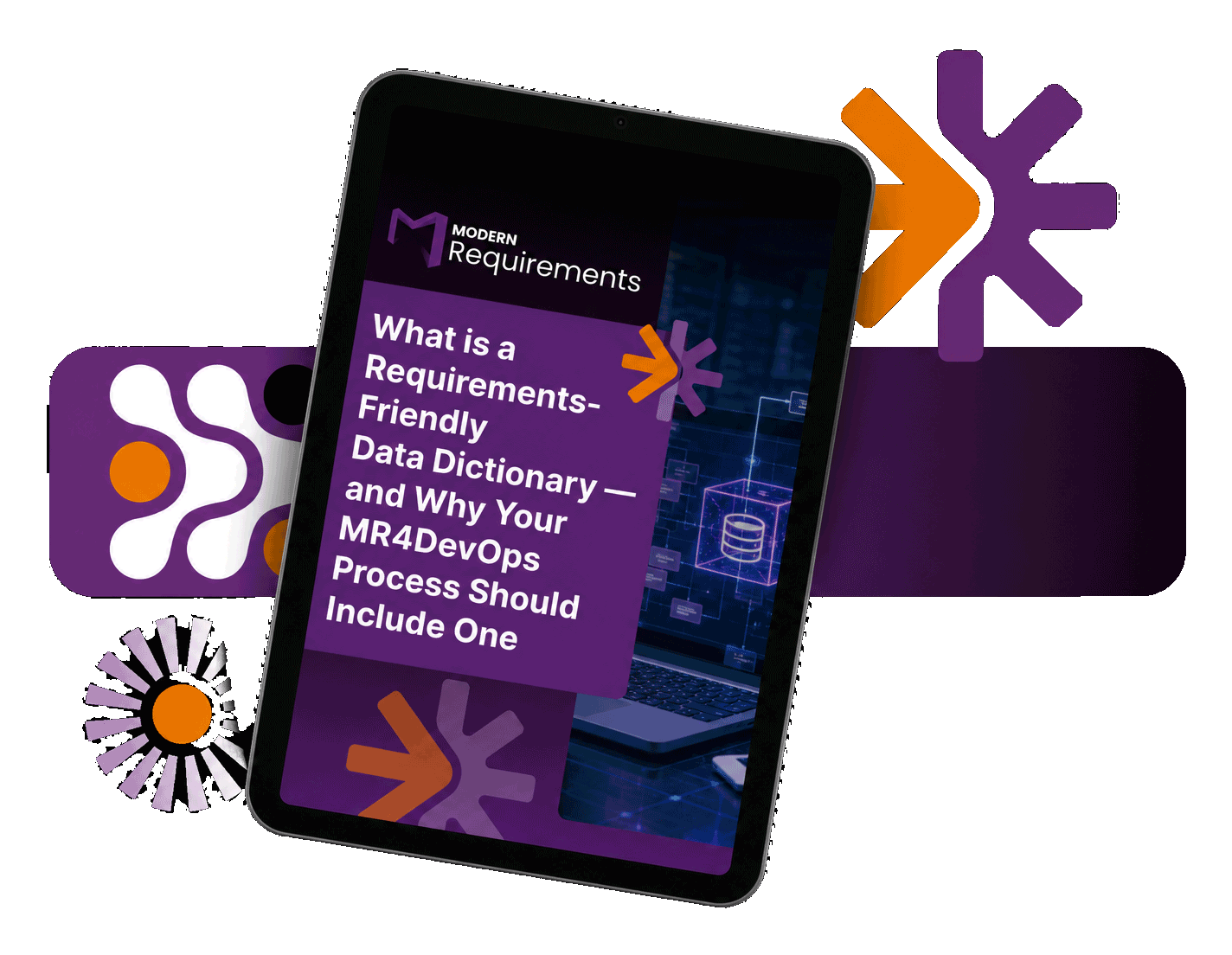
What is a Requirements-Friendly Data Dictionary — and Why Your MR4DevOps Process Should Include One

A practical guide to separating system-managed data requirements from functional requirements using two custom Azure DevOps Work Item Types.

Download Whitepaper Now

Fill out the details in the form to download the whitepaper.

Form not loading? Click here

Why a Requirements-Friendly Data Dictionary Matters

Most teams describe system-managed data inside functional requirements — scattering data rules across user stories, use cases, and requirement statements. An RFDD pulls that information into two purpose-built Work Item Types so it can be reused, reviewed, and traced.

  • Fewer, More Consistent Functional Requirements

    Documenting Records and Record Fields in an RFDD eliminates entire categories of requirements that traditionally repeat across user stories — like “Customer records need a unique identifier” or “A Purchase Order must have at least one Line Item.”

  • Stakeholder-Friendly Terminology

    SMEs already think in terms of records and fields, not entities and attributes. The RFDD uses the language stakeholders use every day — without dictating storage design or implementation.

  • Reusable Data Requirements

    Like a project glossary, RFDD entries become a single source of truth. Business analysts reference (not re-write) Records and Record Fields when eliciting new functional requirements, keeping vocabulary consistent across the whole solution.

  • Completeness Built In

    Property-specific help text guides BAs and SMEs through validation, derivation, archiving, privacy, auditability, and more — so every Record and Field is documented to the same standard.

Le saviez-vous?

A typical functional requirement set contains 30–40% data-related statements that could be replaced with reusable RFDD entries. By managing Records and Record Fields as separate Work Item Types in Azure DevOps, teams report shorter elicitation cycles, fewer review iterations, and far cleaner traceability between data and the capabilities that use it.

Breakdown

The Two RFDD Work Item Types

Record WIT

Represents a type of recorded data — Customer, Purchase Order, Sales Region. Captures aliases, sourcing, growth, archiving, deletion rules, privacy, and stakeholder involvement.
Record Field WIT

Documents a single fact about a Record — with type-specific properties for Labels, Quantities, Date/Time, Descriptions, True/False, Value Sets, Files, and Related Data.

Linked to Requirements

Record and Record Field entries are Related to Epic / User Story / Use Case / Requirement WITs — giving full traceability from a capability to every piece of data it touches.
Industry leader in Requirements Management Solutions for Azure DevOps

Organisation certifiée SOC2

Norme de sécurité

Conformité aux politiques de sécurité des données et de confidentialité

Discover the Power of

Modern Requirements4DevOps - Personalized Demo or Free Trial

Get a personalized demo to see how it fits your team's workflow, or try it yourself - either in your own environment or with our ready-to-use sample projects.

Book a Personalized Demo with us

Book a custom demo with an expert to see how Modern Requirements4DevOps can boost efficiency and streamline requirements.

Try Our Requirements Management Tools

Test in your own environment with your data, or explore our sample setup using pre-built templates like Compliance, BABOK, Product Development, and Agile/SCRUM — no setup needed.