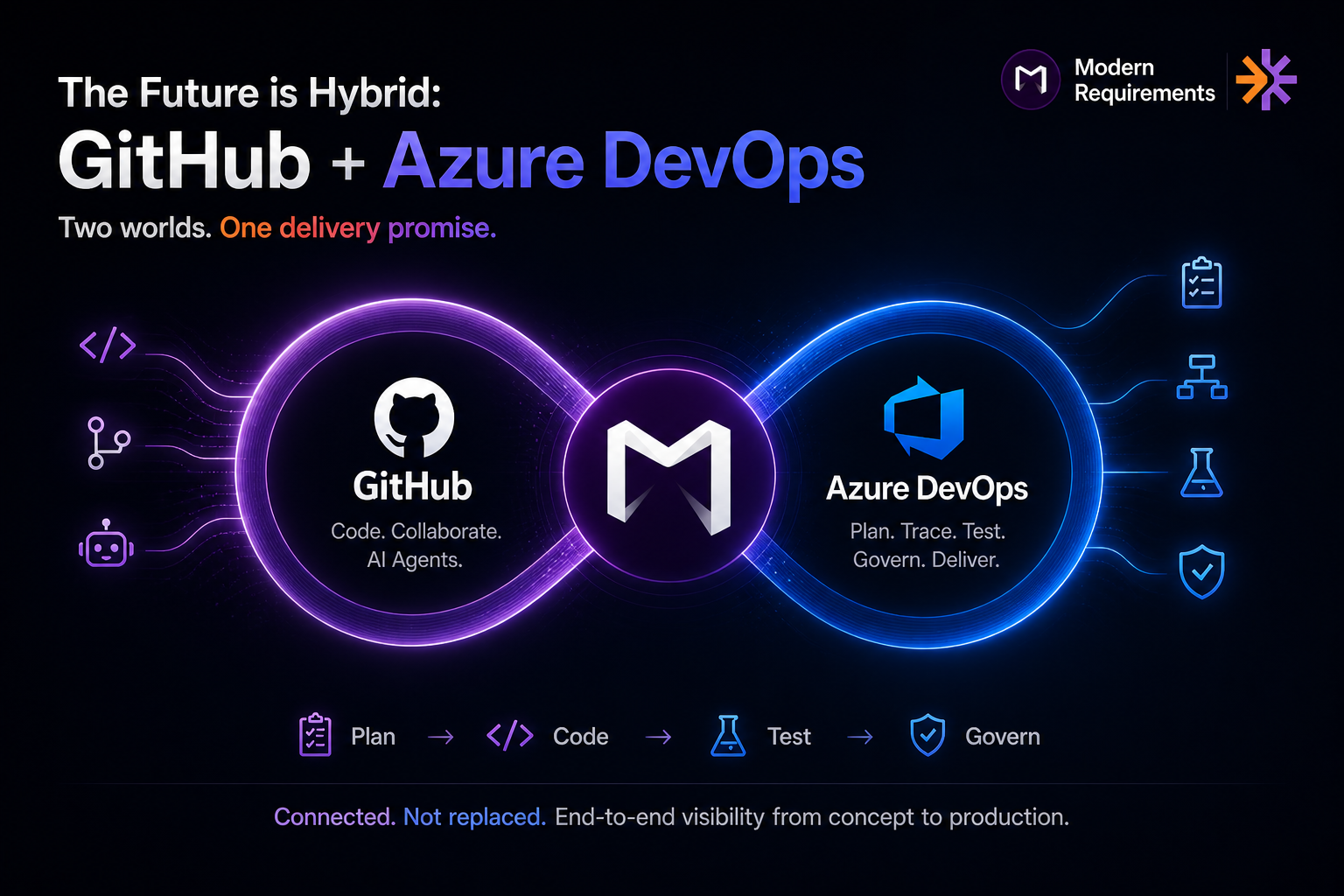
That lands in one place. Large enterprises are not consolidating onto a single pane. They are hardening into a split-stack pattern. GitHub owns repos, source operations, pull-request flow, coding agents. Azure DevOps remains the control layer for planning, requirements, traceability, test orchestration, governance, and release discipline. A lot of teams already run this shape, with GitHub underneath and Azure Boards, Pipelines, and Test Plans carrying the delivery scaffold.
Moderne Anforderungen für DevOps
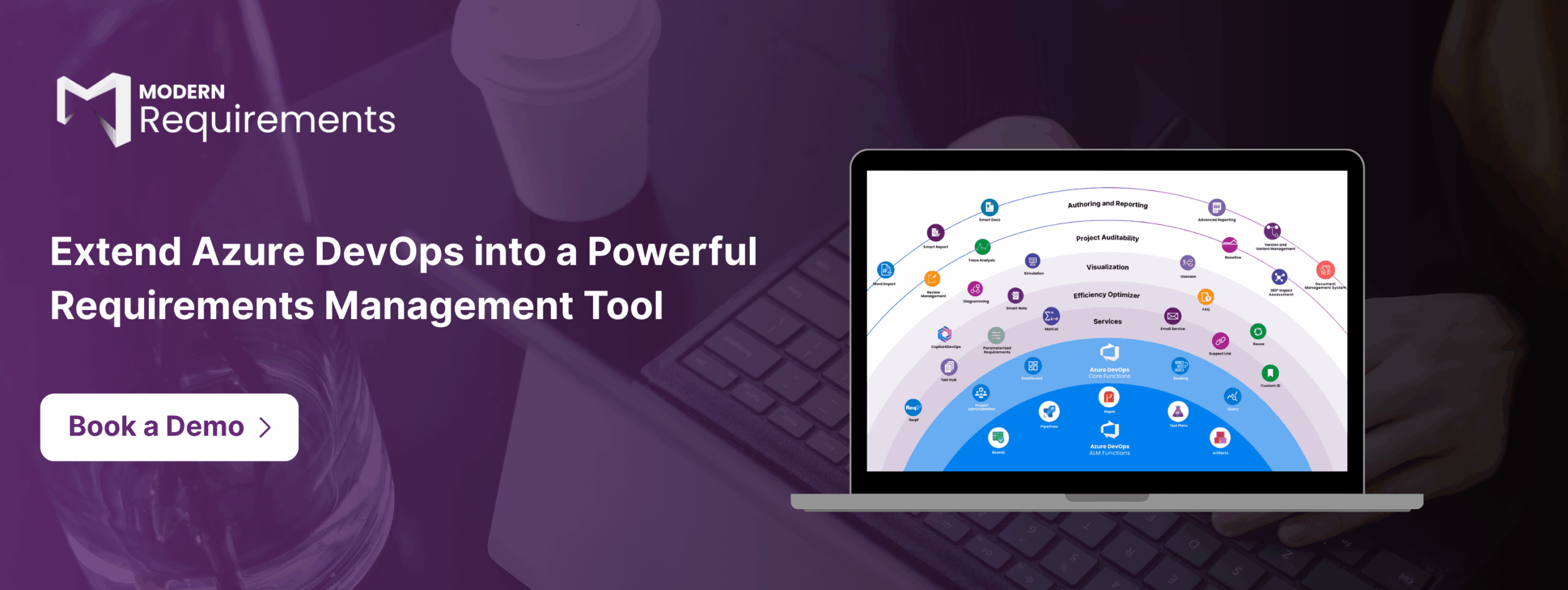
Modern Requirements4DevOps is built for teams running requirements governance, reviews, baselines, traceability, test design, and regulated delivery inside Azure DevOps. That operating model does not collapse because source control sits in GitHub. If Azure Boards stays the system of record for work items, requirements, and compliance evidence, Modern Requirements4DevOps keeps supplying the depth those teams actually need. GitHub Issues and adjacent native artifacts were never designed for lifecycle rigor at that granularity.
We are also making sure hybrid topologies are fully covered, especially environments where GitHub repositories are wired into Azure DevOps projects.
Copilot für DevOps
Copilot4DevOps sits beside GitHub Copilot. Different users. Different workload. GitHub Copilot accelerates code drafting and refactoring. Copilot4DevOps equips the rest of the delivery function—business analysts, product owners, project managers, QA leads, technical writers, compliance stakeholders. It injects AI into requirements work, analysis, documentation, testing, and validation inside Azure DevOps.
Features like Elicit, Analyze, Diagram, Mockup, SOP and Document Generator, Q&A Assistant, Impact Assessment, Convert, and Transform were built for work that does not happen in the IDE. Teams using both products get coverage across the delivery arc, from code creation through documentation and validation.
The two tools are not in the same lane. Customers who use both get the full delivery picture: AI for code, and AI for everything around the code.
Agents4DevOps
Agents4DevOps addresses the other shift already underway. Agent-based development is gaining traction fast, and GitHub Agent HQ has accelerated that motion. Code agents still represent one slice of the enterprise reality.
Agents4DevOps is built for assisted autonomous delivery. Agents can plan, execute, and report across Azure DevOps work items, requirements, tests, and documents while preserving governance, traceability, audit history, and human review (though deploying this against heavily customized inherited processes usually snaps field mappings in unpleasant ways). Enterprise teams need automation they can inspect line by line. That pressure is sharpest in regulated environments, where any decision or artifact mutation may need retrospective examination.
GitHub’s agent posture centers on the developer and the repository. Ours centers on the delivery organization and the work item. Both count. Many enterprises will run both.
What This Means For You?
If you are a current Modern Requirements customer, or evaluating us now, the signal is straightforward. You are aligned with the direction the market is taking.
Large organizations are settling into a model where Azure DevOps carries governance, planning, and traceability while GitHub carries code and coding agents. That is the model we are actively supporting.
Our roadmap reflects that direction. We are expanding GitHub repository support inside Azure DevOps-centered environments. We are improving compatibility across Azure Boards, Pipelines, Test Plans, GitHub Actions, and traceability connected to pull requests, branches, and commits. We are continuing to sharpen Copilot4DevOps and Agents4DevOps as lifecycle-governance products that operate alongside GitHub’s developer tooling.