Non-functional requirements define how well a system must perform, covering speed, security, and reliability. Definition, examples, and why they matter.
Continuer la lecture
Non-functional requirements define how well a system must perform, covering speed, security, and reliability. Definition, examples, and why they matter.
Continuer la lecture
Functional requirements define what a product must do, its features and behaviors. A clear definition, examples, and how they differ from non-functional ones.
Continuer la lecture
A requirements traceability matrix (RTM) maps requirements to the tests and design that verify them, exposing coverage gaps. Definition, example, and FAQs.
Continuer la lecture
Requirements traceability links each requirement to its source, design, and tests so teams can trace changes and prove coverage. Definition, example, and FAQs.
Continuer la lecture
Requirements management is how teams document, organize, and trace a product’s requirements across its lifecycle. Learn what it means, with examples and FAQs.
Continuer la lecture
What ISO/IEC/IEEE 29148 requires, its documents and quality criteria, and how Modern Requirements4DevOps helps teams apply the standard in Azure DevOps.
Continuer la lecture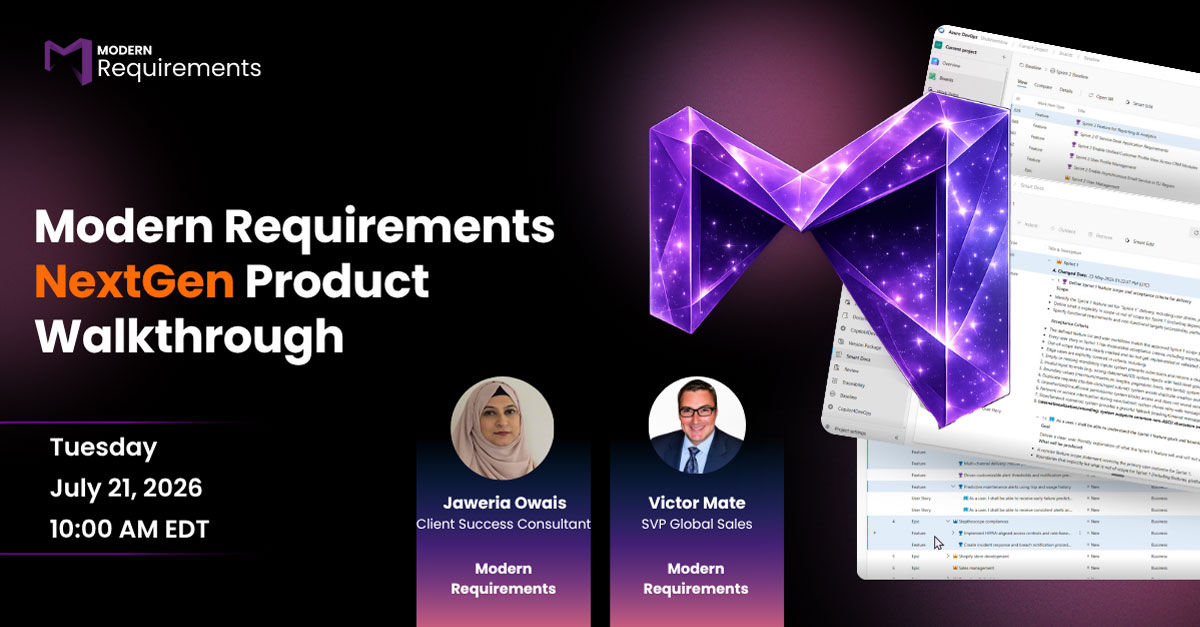
A live tour of the NextGen release. See the rebuilt platform, the refreshed Azure DevOps aligned interface, faster performance, and upgraded workflows, and what changes for your team.
Continuer la lecture
Stop managing requirements manually. Start delivering smarter, with AI built into Azure DevOps.
Continuer la lecture
A practical breakdown of all six BABOK knowledge areas: what each covers, why it matters, and how business analysts apply them in real projects.
Continuer la lecture
Your engineers and quality leads stay accountable for the decisions that matter – while AI takes on the monitoring, flagging, and documentation generation, freeing your team to focus on judgment rather than paperwork.
Continuer la lecture
End-to-end requirements management in Azure DevOps.

AI-powered assistance for DevOps workflows.

Autonomous AI agents for DevOps execution.

Compliance management, built into Azure DevOps.

Real-time data sync across tools and systems.