If you are connected with the life science industry in one way or another, you might have heard about 21 CFR Part 11 compliance. If not, we will explain everything about 21 CFR Part 11 Compliance in this guide.
Let’s start with why it was introduced.
After 1990, organizations started moving from paper-based to digital systems for storing data. But trust did not move as easily. Data can be edited, deleted, or misused without proper control. So, the biggest legal concern for these organizations is how to manage electronic records properly.
As a solution, the FDA (Food and Drug Administration) introduced the 21 CFR Part 11 regulation in 1997. It defines exactly how electronic records and electronic signatures must be handled to be considered valid, trustworthy, and legally equivalent to paper.
Get it wrong, and you’re looking at warning letters, failed audits, or product holds. Get it right, and your entire quality operation runs on a foundation the FDA can trust.
Now, let’s look at the definition of 21 CFR Part 11 and how to implement it.
What is 21 CFR Part 11, and who must comply?
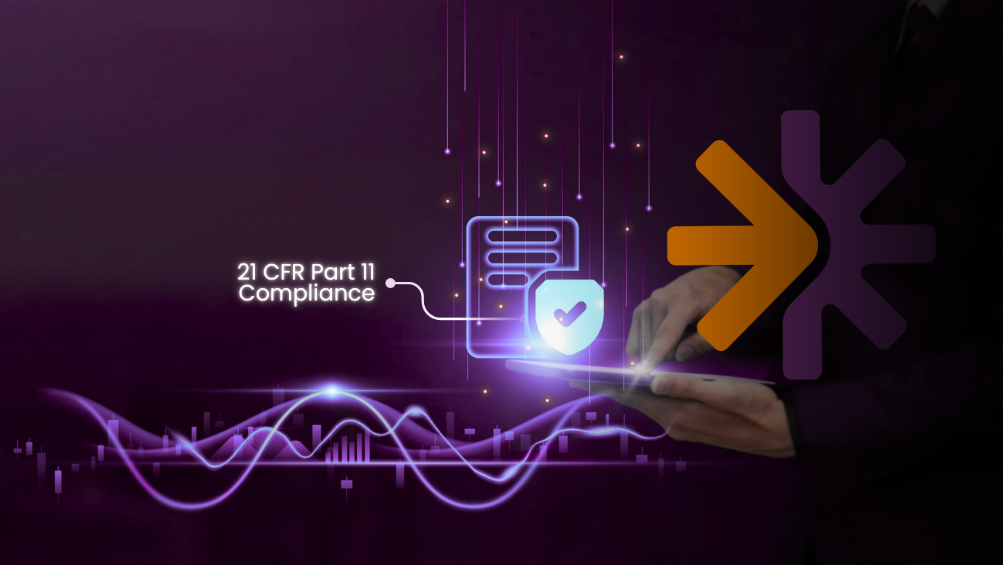
21 CFR Part 11 is an international standard issued by the U.S. Food and Drug Administration that outlines the criteria for using electronic records and electronic signatures in regulated environments. It states that paper-based records can be replaced with electronic records, but only when a digital system ensures data accuracy, integrity, and traceability.
The 21 CFR Part 11 is divided into 3 subparts:
- Subpart A contains the scope of the regulation.
- Subpart B contains rules to store electronic records in digital systems.
- Subpart C contains rules for electronic signatures.
This regulation applies to any organization under FDA oversight, which might be in pharma, biotech, medical devices, or clinical research, and relies on electronic systems for GxP activities.
21 CFR Part 11 requirements: core controls you must implement
21 CFR Part 11 isn’t a single checkbox. It is a set of requirements and controls that work in place to secure electronic records.
Here are some of the core controls you must implement:
- System validation (Part 11.10(a)): Any system used to store electronic records must be tested and documented to prove it works as intended, reliably, and without any failure.
- FDA Audit trail requirements (Part 11.10(e)): When any change is made to a record, the system must log who made the change with the timestamp. The log must be computer-generated and not be manually entered.
- Access controls (Part 11.10(d)): The system must have a secure authorization system. Only authorized users should be able to change records or sign e-records.
- Electronic signatures (Part 11 Subpart C): Each e-signature must be unique and assigned to only a specific user. It must show the signer’s full name, the timestamp of signing, and the purpose of the signature. Also, signatures must be unique to an individual and linked to the record.
- Record retention and retrieval (Part 11.10(c)): Each record must be stored in such a way that authorised team members should be able to access it whenever needed.
- Device and system checks (Part 11.10(h)): Input and output devices should function correctly to avoid incorrect data entry or processing errors.
Want to know more about 21 CFR 21 Part 11? Read FAQs here.
How to implement 21 CFR Part 11 compliance step by step
Now, let’s look at a step-by-step process to implement 21 CFR Part 11 compliance controls stated in the previous section.
1. Define scope and map regulated data
Part 11 doesn’t apply to each system in your organization. It only applies to systems that are associated with FDA-regulated activities. So, identify systems that are used to create and manage records. This might be a document management system, a test management platform, a requirements management platform, etc.
Defining a clear boundary from the start saves resources and time.
2. Validate the system with documented evidence
Next, validate the system and prepare documented proof to prove that it performs accurately, securely, and consistently under real working conditions.
Teams can execute proper qualification protocols, such as Installation Qualification (IQ) and Operational Qualification (OQ) for each system. Also, treat validation as a living process, which means any significant system update triggers re-validation.
3. Control access and enforce accountability
Next, whichever digital system you are using must include a feature that assigns role-based permissions to each user so they can access only what they need. Each user must have a unique ID and password to access records, and every action performed on a record, like editing, reviewing, approving, etc., must be linked with an individual.
4. Enable audit trails and signature workflows
You need to ensure that every change is automatically logged with users’ details and timestamps via the computer, and manual logging is not allowed. Next, set up electronic signatures for review and approval steps. The digital system must link signatures directly to the edited record and capture intent, like approval or review.
5. Establish SOPs and keep teams aligned
If the digital system or software you are using to manage records is 21 CFR Part 11 compliant, that doesn’t mean your process will also be. You also need to train your team on how to use systems in daily work. For that, prepare role-based SOPs that cover steps to perform data entry, review, changes, or issue handling.
Common 21 CFR Part 11 compliance gaps and how to avoid them
Following a process covered in the previous section is not straightforward to implement, but it comes with the following challenges given below:
- Fragmented documentation: When requirements documents, test evidence, approvals, and logs are managed in different systems, it makes it hard to present a complete audit trail. To overcome this challenge, keep all records in a single controlled system.
- Manual approval workflows: Teams use email or papers for performing reviews with no consistent log of who approved what, and then struggle during an audit. To solve this, teams must use a tool that allows them to perform reviews with an e-signature while managing records in the same place.
- Lack of traceability between requirements: When requirements are written, but there is no visibility on how they are connected with test cases and other records, teams struggle to perform change impact assessment and might lose important records.
- Shared user accounts and login: Part 11 requires unique identification for every user. When multiple people use the same login credentials, there is no way to trace an action back to a specific individual.
One solution to overcome all these challenges is use only Part 11-compliant software for managing records during product development.
How Modern Requirements4DevOps supports 21 CFR Part 11 compliance
Modern Requirements4DevOps, a requirements management platform that works inside Azure DevOps, helps teams manage Part 11 compliance as part of daily work, not as a separate activity.
It allows to store all regulated records with version control in a single system. This reduces the risk of missing files and makes it easier to present complete records during audits.
The platform also supports structured reviews with electronic signatures. Teams can review content, provide feedback, and approve within the system. Each action is linked to a user and a timestamp, which builds a clear approval history.
With Modern Requirements4DevOps, teams can maintain traceability across Azure DevOps work items and show compliance during inspection. Also, the tool allows teams to perform controlled change management, which helps in staying audit-ready.
The most important part is that you can assign role-based permissions to every user. Each user has a unique identity, which strengthens accountability and aligns with Part 11 access control expectations.