These failures all occur when teams treat compliance as a separate activity from DevSecOps delivery.
What Audit-Ready DevSecOps Actually Requires in Financial Services
Audit-ready DevSecOps is not built at the end of delivery, but it actually starts in the planning stage. Here is what audit-ready DevSecOps looks like:
Compliance Starts at Requirements, Not After Development
First of all, there should be a single source of truth for compliance, requirements, test cases, and evidence. Each compliance obligation should be converted into actionable security requirements. Furthermore, each drafted requirement should be analyzed to find missing compliances. This way, the developer follows regulatory standards as a normal part of delivery. This way, developers follow compliance such as PCI DSS or SOX as a normal part of delivery.
End-to-End Traceability Across the Pipeline
End-to-end traceability must be integrated into the DevSecOps pipeline. Regulatory obligations, such as PCI DSS, must be linked to actionable work items. This helps in generating a proof of what obligations are implemented, who implemented them, and when across the entire lifecycle system, so DevSecOps remains audit-ready every time.
Embedded Change Control and Approvals
SOX IT change control must be a part of the DevSecOps pipeline. Each change request must record its impact, associated risks, and approval logs, and follow all rules mentioned in regulatory standards. Also, each change log must be immutable.
These ready-to-use and automated change control records help financial firms to be audit-ready at any time without manually collecting evidence for a particular change.
Baseline Management at Every Release
Each release must have a defined baseline, which provides a snapshot of approved requirements. It also manages the version history of the changes. This allows teams to answer audit questions like “What change in this release?” and “Which controls were affected?” Without this baseline, audit review turns into manual reconstruction.
Continuous Evidence Generation, Not Manual Collection
DevSecOps tools must generate evidence continuously. For example, when anything fails, it should instantly log that. Similarly, when someone from the team approves requirements, it should automatically log all approvals and changes. This way, the system automatically generates evidence without any manual dependencies. During regulatory submission, this evidence can be extracted as audit reports.
So, audit-ready DevSecOps is not about tools or pipelines, but it is about managing everything in one place and continuously generating evidence for compliance submission without much manual effort.
How Modern Requirements4DevOps Support Audit-Ready DevSecOps for Financial Services
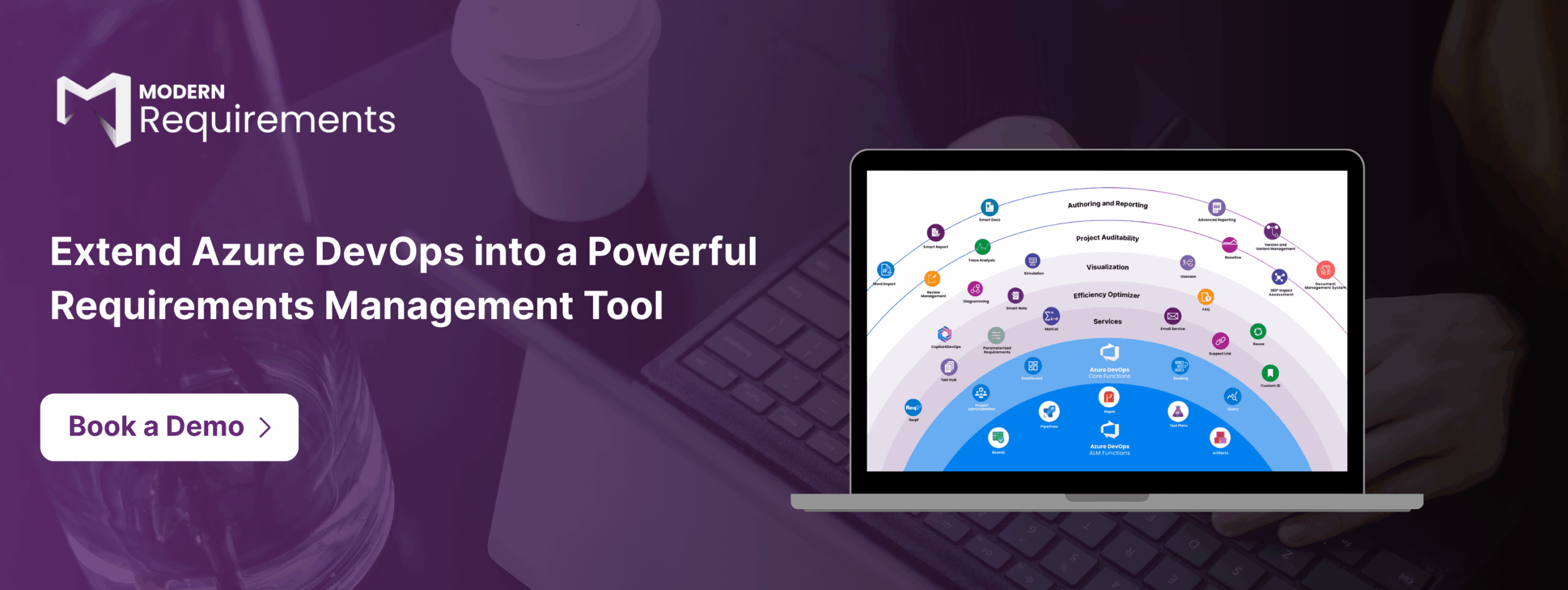
Financial teams don’t need to use separate tools to make their DevSecOps audit-ready if you’re using the right tools, like Modern Requirements4DevOps, which works directly within Azure DevOps. Here is how it can make your DevSecOps audit-ready:
- Turns Azure DevOps into a single audit-ready system: Azure DevOps allows teams to manage compliance obligations, requirements, and test cases in one place within Azure DevOps. Within that, teams can use Modern Requirements4DevOps to manage change control, traceability, and baseline.
- Converts regulations into actionable work items: Copilot4DevOps, an AI assistant, allows drafting development user stories based on compliance obligations and inserts them directly into Azure DevOps. So, compliances like DORA, SOX, and PCI DSS can be integrated into the delivery and not managed separately.
- Ensures end-to-end traceability by default: It allows creating a horizontal and intersectional traceability matrix with a single click. This allows teams to visualize how different compliance items, such as DORA and SOX items, are connected with actual requirements and flag missing requirements.