
ISO 21434: Managing Automotive Cybersecurity Requirements
Learn what ISO 21434 requires, how the TARA-to-verification trace chain...
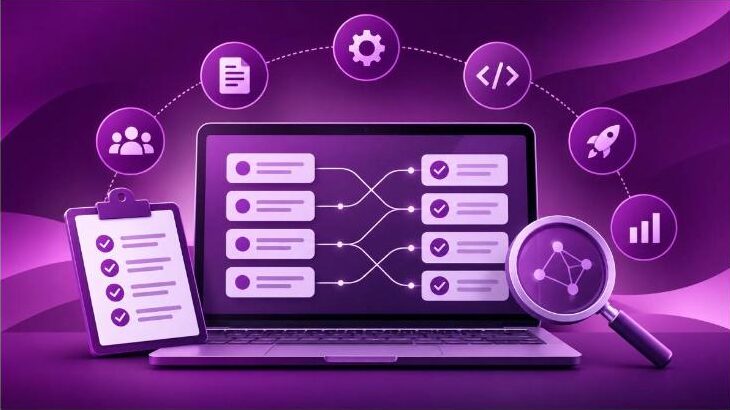
A requirements traceability tool helps development teams link requirements to design decisions, test cases, defects, and other project artefacts. It makes it easy to verify if the requirements have been fulfilled, tested, and reviewed prior to releasing the product.
Traceability is particularly important in industries such as aerospace, automotive, medical devices, and industrial engineering, where teams must demonstrate that their development processes meet applicable industry standards and regulatory requirements.
Traditionally, teams managed requirements traceability using spreadsheets. However, this approach is no longer practical for complex projects with frequently changing requirements. Every time a requirement is added, modified, or removed, the team must manually update the related tests, design documents, and traceability links. Keeping everything accurate becomes a headache, especially when projects involve hundreds or thousands of requirements. A single missed update can leave outdated links, overlooked tests, or gaps in requirement coverage.
Requirements traceability tools simplify this process by automating link management and providing features such as change impact analysis, coverage analysis, traceability matrices, and reporting. Teams can identify missing connections, understand the impact of requirement changes, and maintain better control over project documentation.
This guide compares nine requirements traceability tools in 2027, covering their key features, practical applications, strengths, limitations, and suitability for different engineering and software development environments.
What traceability tools do: link requirements to design decisions, tests, and defects, and why spreadsheets fall short.
The tools at a glance: G2 ratings, platforms, and best-fit use cases for nine tools.
Tool-by-tool comparison: key traceability features, strengths, and limitations of each tool.
How to choose: five checks covering coverage, change impact, verification, audit history, and integration.
Common questions: Excel-based traceability, must-have features, and standards that require bidirectional traceability.
| Tool | G2 Review | Platform | Best For |
|---|---|---|---|
| Exigences modernes4DevOps | 4.8/5 (101 reviews) | Azure DevOps | Native traceability |
| Jama Connect | 4.3/5 (233 reviews) | Standalone | Regulated engineering |
| IBM DOORS Next | 4.0/5 (136 reviews) | IBM ELM | Large engineering programs |
| Siemens Polarion | 4.2/5 (165 reviews) | Enterprise ALM | Automotive and manufacturing |
| PTC Codebeamer | 4.3/5 (141 reviews) | ALM | Product-line engineering |
| Visure Requirements ALM | 4.2/5 (9 reviews) | Standalone | Safety-critical industries |
| Perforce ALM | 4.1/5 (102 reviews) | ALM | Requirements and QA |
| Inflectra SpiraTeam | 4.2/5 (32 reviews) | ALM | Software testing |
| easeRequirements | Not available | Jira app | Jira-based requirements |
Modern Requirements4DevOps adds requirements management, documentation, reviews, and traceability capabilities to Microsoft Azure DevOps. It helps teams connect compliance clauses, requirements, test cases, and development tasks within their existing environment using its traceability features and supports tracking relationships throughout development.
The best part? The Trace Analysis feature generates matrices from live Azure DevOps work items. So, when an ADO work item updates, traceability matrices also update accordingly. For example, medical software teams can connect ISO 13485 requirements with user stories, development tasks, and verification tests. This helps identify missing links and incomplete test coverage, as explained in the requirements coverage analysis guide.
Key traceability features
Strengths
Limitations
The Jama Connect requirements management tool has been developed for teams involved in working on systems and engineering-related projects. It facilitates the integration of requirements, testing, risk, and reviews into one platform.
In the case of automobile engineering, for example, there is a change in the requirements of the braking system. In this situation, the engineers need to determine the other requirements, verifications, and project artifacts that may be impacted by such changes. Herein lies the advantage of using Jama Connect for such investigations.
Review Center is another component that is provided by the software and enables structured reviews by engineers, product managers, QA professionals, etc.
Key traceability features
Limitations
Best for large engineering programs.
IBM DOORS Next is a part of IBM Engineering Lifecycle Management and helps businesses manage requirements in intricate engineering projects.
It becomes especially useful for those who deal with vast requirements management projects, several configurations of products, and rigorous change control processes.
Using the platform, engineers can link requirements to other development and test documentation. Combined with other IBM Engineering Lifecycle Management solutions, it becomes possible to create connections between various engineering tasks.
IBM DOORS Next also supports baselines, streams, change sets, and configuration management to assist people in working with the various states of the project.
Key traceability features
Limitations
The Siemens Polarion ALM application lifecycle management solution combines requirements management, testing, change management, and collaboration into a single application lifecycle management solution. It is aimed at engineering departments that require linking of product specifications to their verification during the development process.
One of the interesting features of the solution is Polarion LiveDocs, which enables teams to document their requirements in a structured document and link them to other project documentation.
This approach suits engineers who prefer working with document-oriented specifications while benefiting from the structure, traceability, and data management capabilities of a requirements database
Key traceability features
Limitations
Best for teams managing multiple product variants and configurations.
The PTC Codebeamer is an ALM solution that assists engineering teams in maintaining end-to-end traceability during product development. It integrates requirements, design artifacts, development activities, test cases, defects, and releases, thus offering insight into relationships between engineering activities.
For instance, when an automobile company is developing several types of cars on one platform, there are usually some common needs that exist along with model-based components, software functionalities, and safety considerations. Codebeamer assists in handling these variations while keeping traceability of common and variant-based engineering information.
Key Traceability Capabilities
Limitations
Advanced product-line engineering may require PTC Pure Variants integration. Managing complex configurations, reusable data, and traceability relationships also requires careful planning.
Overall, Codebeamer helps teams maintain requirement visibility, assess change impacts, verify test coverage, and manage traceability across complex product configurations.
Best for safety-critical development.
Visure Requirements ALM is a requirements management tool designed specifically for engineering companies that need to associate their requirements, risks, test cases, and other compliance information.
This approach is very helpful in development where safety is paramount because any missing requirement or verification step may create problems during technical evaluation.
A case in point is a company making medical devices, which would require linking a product requirement with a particular hazard, risk control measures, and verification test.
The Visure tool provides functionality that ensures traceability, whereby the user can identify any gaps in linking.
The software also features Vivia, an AI assistant that is specifically aimed at assisting with requirements engineering. It supports requirements analysis, detecting ambiguities, test case generation, and traceability.
Also included in this software is Vivia, an AI assistant that focuses on requirements engineering. Vivia helps in requirements analysis, identifying ambiguity, generating test cases, and traceability.
Key traceability features
Limitations
Best for requirements-driven testing.
Perforce ALM, earlier referred to as Helix ALM, links together requirements management, test case management, and issue tracking.
This tool is aimed at teams requiring maintaining associations between product requirements and tests validating them.
An example of a real-world scenario is when the software team prepares to release its next version with a number of requirements already approved, but not all tests have been performed or have failed.
Perforce ALM offers the ability to make use of traceability and coverage reporting features that allow you to investigate these dependencies.
Additionally, the platform enables the creation of test cases using approved requirements. These can act as a basis for verification planning. It is still necessary to analyze these test cases to check whether they have the right conditions and procedures.
Key traceability features
Limitations
Best for software QA and Agile teams.
Inflectra SpiraTeam offers requirements management, test management, defect management, and Agile project management in a single platform.
The platform is made for software development teams in order to be able to organize their activities while keeping track of requirement fulfillment and the testing process.
A software company developing a customer portal might have several requirements such as user registration, authentication, account management, and payment processing.
Each requirement needs appropriate testing before release.
SpiraTeam lets you link test cases to requirements and check the coverage status of the requirements by the test cases. In case you discover any defect while testing, the linked records will allow you to figure out which requirement has not been fulfilled.
It can be helpful for teams that would like to connect test cases to requirements without using any tracking documents.
Key traceability features
Limitations
Best for Jira-based teams.
The easeRequirements, which used to be called R4J, brings requirements management to Jira.
This tool is meant for those organizations that have Jira as their task tracking solution for software development and would like to have greater control over their requirements management process.
While Jira is able to connect various tasks together, sometimes engineering teams require more from the requirements management process.
EaseRequirements expands the Jira environment to accommodate the following actions.
For instance, a software development team could have customers’ requirements, technical requirements, and tasks in the Jira environment.
It is important for the team to know which lower-level requirements satisfy the customer requirement and whether the associated development activity has been done.
easeRequirements helps its users to create an organized hierarchy of the requirements and analyze relationships between connected Jira tickets.
Key traceability features
Limitations
The most suitable option will depend on where your product development takes place, the dependencies you need to map, and the information you need for review or auditing.
Begin by assessing your current development environment. If your developers currently work in Azure DevOps, then try out Modern Requirements4DevOps. If your platform is Jira, then try out easeRequirements.
To consider multidisciplinary engineering, you can evaluate Jama Connect, IBM DOORS Next, Polarion, Codebeamer, and Visure in terms of your needs.
Before selecting a tool, check these five areas:

A requirements traceability tool is software that is designed to enable easier tracking of the requirements throughout the development process. The software helps trace the requirements back to the design documents, test cases, and risks and defects.
Indeed, Excel could be used to generate a requirements traceability matrix (RTM) by entering requirement IDs, descriptions, associated tests, and status. This approach is effective in small projects, but becomes challenging in large-scale projects as manual management of links and tracking of changes may be complicated.
The requirements traceability tool must provide bidirectional traceability capability, automated traceability matrix creation, impact analysis, gap analysis, versioning, baseline, and auditing capabilities. It must also be integrated with other software tools used for development and testing to preserve the integrity of links.
Standards such as DO-178C, ISO 26262, IEC 62304, IEC 61508, ISO/IEC/IEEE 29148, and Automotive SPICE emphasise bidirectional traceability throughout product development.
Learn what ISO 21434 requires, how the TARA-to-verification trace chain...
Azure DevOps only imports CSV files. See how native CSV...
Small banks spend 3x more of their budget on compliance....

End-to-end requirements management in Azure DevOps.
AI-powered assistance for DevOps workflows.

Autonomous AI agents for DevOps execution.

Compliance management, built into Azure DevOps.
Real-time data sync across tools and systems.