From Obligation to Evidence Across DORA, NIST, ISO 27001, SOC 2, and PCI DSS
Financial institutions are operating in a compliance environment that is fundamentally different from just a few years ago. Regulatory expectations have increased, reporting timelines have tightened, and the cost of non-compliance has grown significantly.
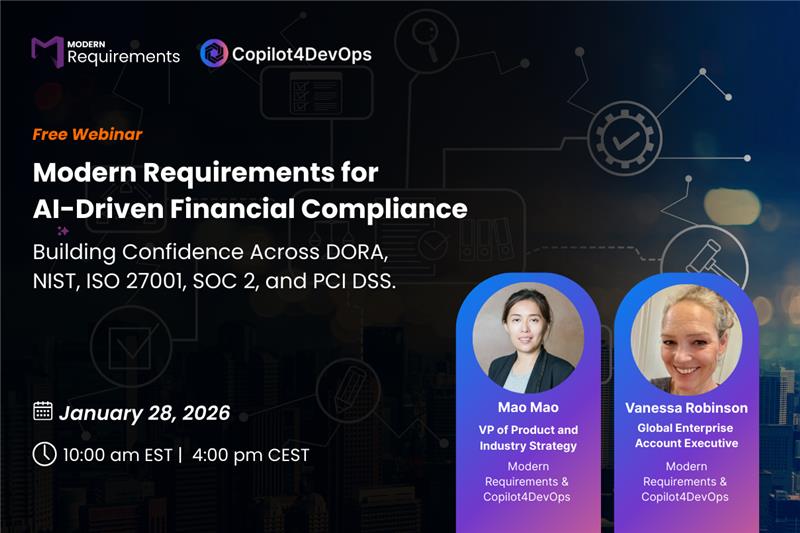
In our recent webinar, Modern Requirements for AI-Driven Financial Compliance, we explored how organizations can move from reactive, document-heavy compliance efforts to a more structured, traceable, and audit-ready approach using modern requirements management and AI.
Below is a detailed summary of the key themes and takeaways from each part of the session.
Compliance Is Now a Core Product Constraint
One of the central themes of the webinar was the shift in how compliance impacts product delivery.
Between 2016 and 2023, compliance hours increased by more than 60 percent, while IT compliance spend rose by nearly 40 percent. In the United States alone, 99 percent of financial institutions report rising compliance costs. These increases are not isolated to compliance teams. They directly affect delivery timelines, architectural decisions, and release risk across product and engineering teams.
Compliance is no longer something that happens after development. It has become a core product constraint, influencing how systems are designed and how confidently teams can release changes.
Different Regulatory Models, Same Pressure
The webinar highlighted that while regulatory structures differ by region, the pressure on teams is remarkably consistent.
In the United States, compliance oversight is fragmented across multiple regulators such as the SEC, FINRA, OCC, and state authorities. This fragmentation increases enforcement complexity and raises the likelihood that findings become delivery blockers. Expectations around cyber incident reporting, often within 72 hours, add further strain.
In the European Union, regulation is more centralized but significantly broader in scope. Frameworks such as GDPR and PSD2 already require deep operational controls, and the introduction of DORA has raised expectations around operational resilience, testing, incident management, and third-party risk.
Despite these structural differences, the outcome is the same. Teams are expected to produce more evidence, respond faster, and face higher penalties when gaps are found.
The Real Pain for Product, Business, and Compliance Teams
A major portion of the webinar focused on the day-to-day challenges teams face when trying to operationalize compliance.
Regulations are written in legal language, not product or engineering terms. Teams must interpret and translate obligations from multiple overlapping frameworks such as DORA, NIST, ISO 27001, SOC 2, and PCI DSS. This work is often spread across disconnected tools including Word documents, spreadsheets, email threads, and ticketing systems.
When regulations change, many organizations lack a clear way to assess impact. Teams struggle to answer basic questions such as which requirements are affected, which controls need updating, and what evidence must be regenerated. The result is reactive work, duplicated effort, and increased audit risk.
From Obligation to Evidence with Modern Requirements
The webinar then shifted from challenges to solutions, introducing how Modern Requirements helps bridge the gap between regulatory intent and delivery execution.
Modern Requirements enables teams to transform regulatory obligations into structured, delivery-ready requirements that are clear, testable, and approved. Instead of scattered interpretations, organizations gain a single source of truth for regulatory intent.
End-to-end traceability is built directly into Azure DevOps. Teams can trace requirements to user stories, test cases, test results, and evidence artifacts. When changes occur, the impact is immediately visible, reducing uncertainty and manual analysis.
This approach allows compliance to be embedded into delivery workflows rather than managed as a separate, downstream activity.
The Role of AI in Continuous Compliance
AI was a key focus throughout the session, not as a replacement for human judgment, but as an accelerator for consistency, quality, and visibility.
Built-in AI analysis and compliance agents help teams generate requirements from regulatory text, identify gaps, and maintain approvals and audit trails by design. AI supports continuous audit readiness by assisting with reviews, impact assessment, and evidence preparation.
Importantly, all AI-assisted output remains reviewable, auditable, and governed, which is critical in regulated environments.
Demonstration Highlights
The live demonstration walked through three core areas:
- Modern Requirements for requirements management, showing how regulatory obligations become structured requirements with traceability.
- Copilot4DevOps for regulatory analysis and impact assessment, demonstrating how AI assists with interpreting regulations and assessing change.
- AI agents for complex compliance workflows, highlighting how automation supports continuous compliance without increasing risk.
Together, these capabilities illustrated how organizations can move from manual, document-driven compliance to a modern, scalable approach.
Key Takeaway: Confidence Through Modern Requirements
The overarching message of the webinar was clear. Compliance is not getting simpler, and traditional approaches cannot keep up.
By combining modern requirements management with AI, organizations can build compliance into delivery, maintain continuous audit readiness, and respond to regulatory change with confidence. Instead of scrambling for evidence, teams can focus on delivering value while staying aligned with regulatory expectations.