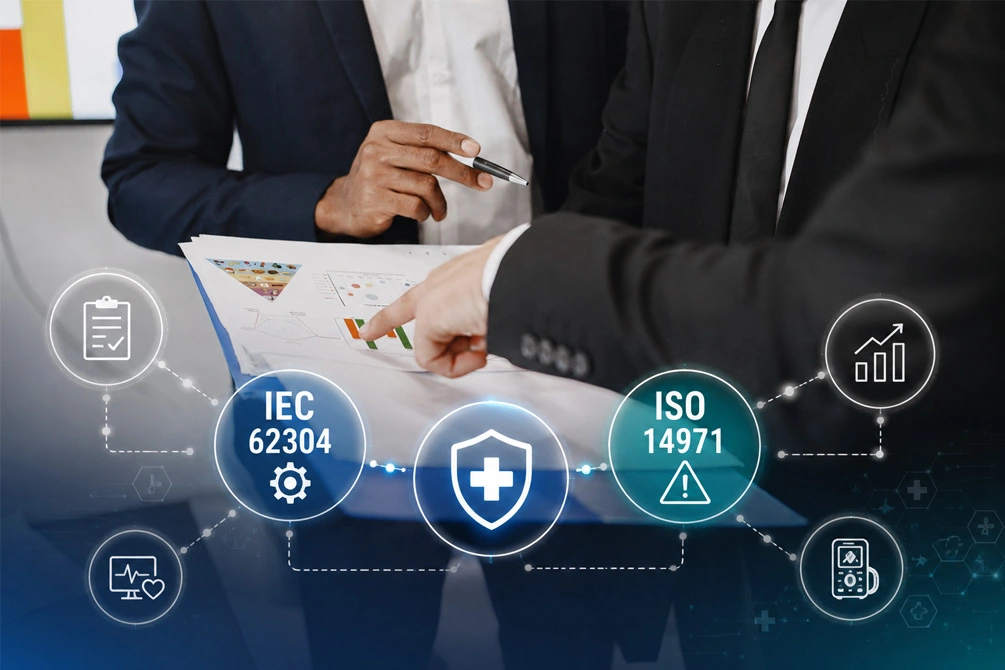
Without mapping and end-to-end traceability between risk controls and software requirements, teams may meet documentation requirements but still fail to demonstrate that risks are controlled in a compliant way.
A Practical Traceability Model for IEC 62304 + ISO 14971
ISO 14971 and IEC 62304 integration helps in creating a single source of truth that connects software requirements to safety links. Here is how medical device software traceability works:
1. Define Intended Use and Software System Context
The first step is to define the purpose of the software system and start with SDLC that aligns with IEC 62304. Teams write down raw requirements, epics, features, user stories, test cases, etc., and connect them using traceability matrices.
2. Hazard Identification, Risk Analysis, and Risk Mitigation
The next step is to perform a structured hazard analysis using ISO 14971. Teams also need to identify the severity that arises due to hazards and risk controls to mitigate them. Also, all these should be connected using an ISO 14971 traceability matrix.
3. Translate Risk Controls into Software Requirements and Map Them
Next, each risk mitigation strategy should be converted into an actionable software requirement under IEC 62304.
Par exemple :
- Hazard: Wrong dosage calculation
- Risk control: Limit overdosing.
- Software requirement: The system shall restrict dosage input from 0 to 1.
The final mapping between risk controls and software requirements looks something like:
- Hazard -> Risk -> Control -> Requirement -> Design -> Code
4. Verification and Validation with Traceability Coverage
Verification must prove that risk controls are effective.
Each test case must:
- Link back to a software requirement
- Indirectly link to the originating risk
Teams should track:
- Requirement-to-test coverage
- Risk-to-test coverage
- Pass/fail status of safety-critical tests
5. Change Management and Trace Impact Analysis
Every change must trigger:
- Impact analysis across trace links
- Risk reassessment (ISO 14971)
- Update of requirements and tests (IEC 62304)
Traceability ensures that no affected artifact is missed during updates.
Implement Bidirectional Traceability
Bidirectional traceability connects artifacts across both IEC 62304 and ISO 14971 in two directions.
Forward traceability is from hazard to risk controls to requirements, design, and test cases. With this, teams can identify that every risk is addressed. On the other hand, backward traceability confirms that every implemented feature maps to defined risks and adheres to IEC 62304 guidelines.
This is how risk management can be a part of SDLC in medical device software development, and traceability connects IEC 62304 and ISO 14971. It also helps in preparing audit-ready evidence continuously.
Challenges that Teams Face while Managing Traceability Between IEC 62304 and ISO 14971
- No single source of truth: Many teams manage software development pipelines and risk controls in different tools, which makes it harder to connect risk controls with development requirements.
- Derived requirements lack risk linkage: Safety logic added during design or coding is not traced back to a specific hazard, weakening compliance evidence.
- Change impact not fully traced: When end-to-end traceability is not in place, teams struggle to find impacted requirements due to particular changes. This can also lead to compliance gaps, and teams face rejection for getting IEC 62304 and ISO 14971 certifications.
- Incomplete bidirectional traceability: Forward links may exist, but backward trace checks are missing, making it hard to prove that every implementation ties back to a defined risk.
These challenges are common while managing traceability between IEC 62304 and ISO 14971, but they are not impossible to solve. By using a requirements management tool that offers end-to-end traceability, teams can solve them. Let’s look at how in the next section.
How Modern Requirements4DevOps Help Regulated Medical Device Teams
Modern Requirements4DevOps, a requirements management tool, is specifically built for teams working on medical software device development. It helps in achieving IEC 62304 and ISO 14971 compliance by offering the following features:
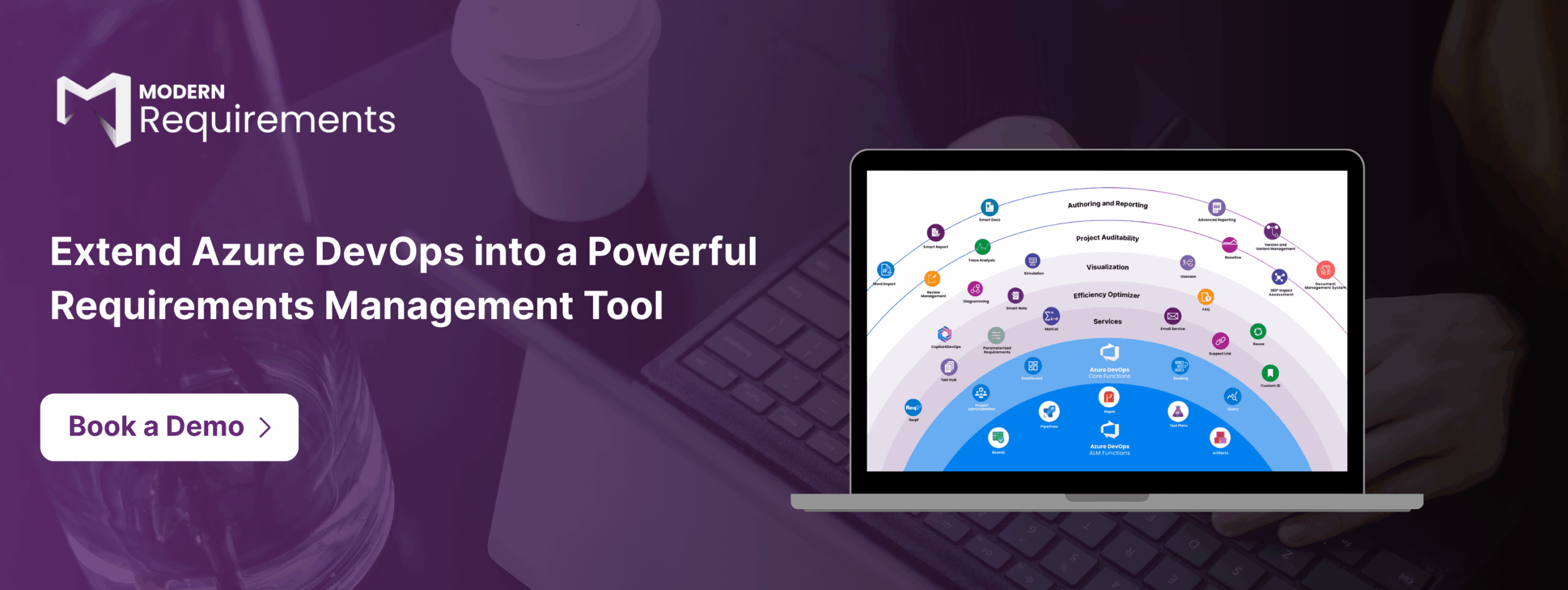
- Single source of truth: Modern Requirements4DevOps works as an extension within Azure DevOps. Teams can store all of their requirements, whether they are related to IEC 62304 or ISO 14971, or test cases and validation results; everything stays in one place. So, it becomes easier to manage.
- Map risk controls to backlog work items: Teams can define hazards and risk controls within Azure DevOps. Then, they can use traceability matrices to connect risk controls with backlog work items.
- By using a horizontal traceability matrix, teams can visualize the connection between: Hazards -> Risk Controls -> Requirements -> Tests. With this, teams can identify missing risk controls.