Skip to content

How Modern Requirements4DevOps Supports FedRAMP Compliance

Modern Requirements supports FedRAMP compliance.

Key Takeaways

  • Federal agencies in the U.S. are expected to work with cloud tools that fall under FedRAMP-authorized environments. It’s a basic compliance requirement for any system that handles government data.
  • Azure DevOps Services, which is Microsoft’s public cloud version, isn’t part of the FedRAMP-approved list. So, if you’re using that version, the tools inside it, including extensions, don’t automatically meet FedRAMP standards.
  • On the other hand, Azure Government is built specifically for federal workloads and is officially listed as FedRAMP High authorized in the government’s own marketplace.
  • Modern Requirements4DevOps, an end-to-end requirements management solution, doesn’t carry a separate FedRAMP certification. However, when you install Modern Requirements4DevOps inside Azure Government or in an on-premise environment that already meets FedRAMP requirements, the entire setup stays within a compliant zone. That’s what makes it suitable for regulated work without needing additional certification.

What is FedRAMP and Why It Matters?

The FedRAMP (Federal Risk and Authorization Management Program) program was launched in December 2011 by the U.S. government to introduce a standardized approach for providing rules for how cloud services must protect sensitive federal data under the Federal Information Security Management Act (FISMA). Its main aim is to accelerate the adoption of secure and trusted cloud tools across U.S. federal agencies.

FedRAMP offers three ways for cloud services to get authorized:

  • Provisional Authorization to Operate (P-ATO): Reviewed and approved by the FedRAMP Joint Authorization Board (JAB).
  • Authorization to Operate (ATO): Granted directly by a specific federal agency that intends to use the service.

CSP Supplied Package: Created by the Cloud Service Provider (CSP) itself to show how it meets FedRAMP requirements.

All three paths require a full security assessment from an approved third-party assessment organization (3PAO), followed by a technical review by the FedRAMP Program Management Office (PMO).

Why does this matter?

Because if a cloud service is not FedRAMP compliant, many federal agencies legally can’t use it. And for contractors or partners, using unapproved tools can lead to delays or even disqualification from projects.

Azure Deployment Options and FedRAMP Compliance

Deployment Type
FedRAMP Compliance
Details
Azure DevOps Services (Public)
Not FedRAMP authorized
This is the commercial cloud version. It doesn’t fall under Microsoft’s FedRAMP authorization. Tools used here are considered outside the FedRAMP boundary.
Azure DevOps Server (On-Premises)
Depends on your setup
If hosted inside a FedRAMP-authorized network, it can meet compliance. But the responsibility for security and documentation stays with your team.
Azure Government
FedRAMP High authorized
This is Microsoft’s dedicated cloud for U.S. government use. It’s listed in the official FedRAMP Marketplace and includes DevOps services as part of the compliant boundary.

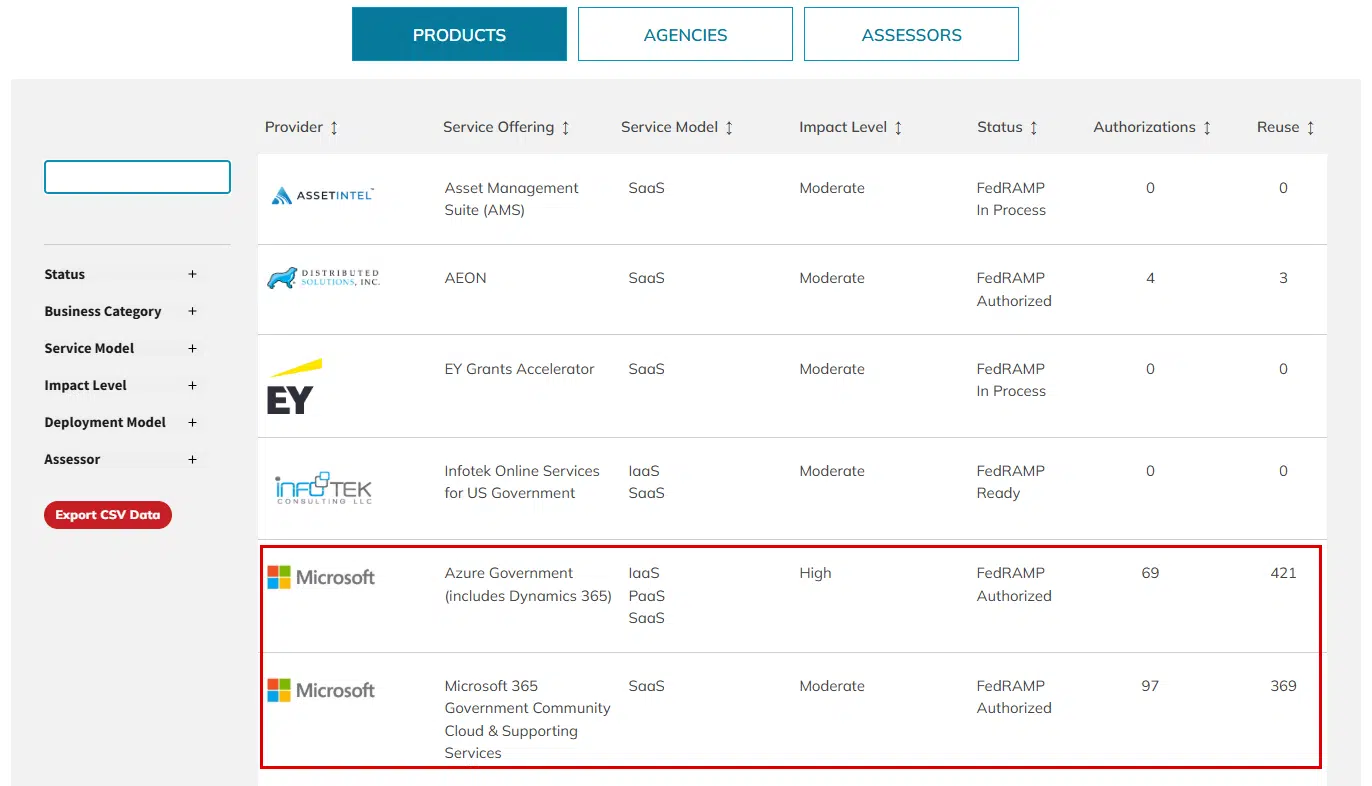
In the screenshot below, you can clearly see that Azure Government is listed as a FedRAMP-authorized product. It’s not an assumption; it’s publicly verified.

Azure Government achieves FedRAMP authorization and listing.
Azure Government is now fully FedRAMP authorized and listed in the FedRAMP Marketplace.

Here Is How Modern Requirements4DevOps Operates Within FedRAMP-compliant Boundaries

Modern Requirements4DevOps is an end-to-end requirements management solution built to work inside Azure DevOps.

Because Modern Requirements4DevOps works as an extension within Azure DevOps, its compliance status depends fully on where Azure DevOps itself is hosted.

  • When Modern Requirements4DevOps is installed within Azure DevOps Services (public cloud), it runs outside the FedRAMP boundary, as the public version of Azure DevOps is not FedRAMP authorized.
  • When Modern Requirements4DevOps is installed within Azure Government, which is already FedRAMP High authorized, it operates entirely inside the compliant boundary. In this case, no extra certification is needed.
  • The same applies to on-premises Azure DevOps Server setups that are already part of a FedRAMP-authorized environment. Modern Requirements4DevOps inherits this compliance as long as everything remains within the secure network.

As it is clear that Modern Requirements4DevOps doesn’t store or process data outside Azure DevOps. So, no external risk is introduced. Everything stays within your chosen and authorized infrastructure, which allows Modern Requirements4DevOps to be used safely in high-compliance environments, as long as the hosting platform is already FedRAMP compliant.

Getting Started With Modern Requirements4DevOps: A Checklist

Before you start using the Modern Requirements4DevOps within Azure, follow the checklist below:

  • Assess where your Azure DevOps is running. Is it in the public cloud, Azure Government, or on a self-hosted server?
  • Next, ensure that your setup matches your FedRAMP requirements. Public cloud won’t work if you need to stay inside a certified boundary. You need to use either Azure Government or a self-hosted Azure instance that is FedRAMP certified.
  • Install Modern Requirements 4DevOps into that same boundary.
  • Use built-in tools like Azure Policy and Microsoft Defender to make sure the self-hosted environment stays compliant over time.

Frequently Asked Questions (FAQs)

1. Does Modern Requirements4DevOps have its own FedRAMP certification?

No, it doesn’t. Modern Requirements4DevOps doesn’t need to acquire FedRAMP certification as it is not a separate cloud service and works within Azure Government, which is already FedRAMP authorized. So, MR4DevOps inherits all security features of Azure Government.

Not at all. Everything, including requirements, diagrams, use cases, and comments, stays within Azure. Modern Requirements4DevOps doesn’t host or move your data elsewhere.

In most cases, no. Because Modern Requirements4DevOps doesn’t introduce a new cloud boundary, it falls under the existing FedRAMP coverage of Azure Government. Your security and compliance team can usually approve it based on that.

Table of Contents

Start using Modern Requirements today

✅ Define, manage, and trace requirements within Azure DevOps
✅ Collaborate seamlessly across regulated teams
✅ Get started for FREE—no credit card required

Recent Articles