BABOK Strategy Analysis: How Business Analysts Define the Right Problem Before Solving It
A deep dive into BABOK strategy analysis. Covers current state...
Managing cybersecurity risk across complex IT systems is not a joke. Many organizations struggle to deal with growing requirements, strict audits, and constant pressure to stay compliant. If you are already handling sensitive data or working with federal security requirements, you know that the following NIST Risk Management Framework (NIST RMF) is unavoidable.
The real problem? It starts during execution. When controls are defined, but tracking what is implemented, who approved it, and where the evidence lives becomes unclear, teams spend more time managing information than risk.
So, to convert compliance headaches into a security advantage, organizations are required to integrate traceability into the system development workflow. This helps in tracking which NIST RMF security controls are implemented and how they are implemented.
This blog will help you to understand NIST RMF, why traceability matters, and how to trace NIST RMF controls and requirements during IT system development.
The NIST RMF compliance, a Risk Management Framework introduced by the National Institute of Standards and Technology, provides a structured approach for managing security and privacy risks, such as unauthorized access, data breaches, and system failures in IT systems. It covers how to identify security risks, apply security controls, verify those controls, and continuously monitor the system.
RMF is generally used in regulatory environments. Organizations developing IT systems used in government, defense, healthcare, finance, etc., sectors, or handling sensitive data, generally follow RMF.
The framework follows seven steps:
Each step builds on the previous one, making security an ongoing process rather than a checklist.

As discussed in the previous section, RMF has seven steps, and each step depends on the previous one. Without a clear connection between requirements, controls, and test results, the flow breaks and creates compliance gaps. Here are a few reasons showcasing the importance of traceability in implementing RMF:
In short, traceability plays an important role in connecting each step of RMF and reducing the risk of missed compliance and penalties.
Managing NIST 800-37 requirements traceability looks straightforward. However, when the project grows and needs to manage thousands of work items, it becomes hard to track security controls and changes in requirements. Here are some of the common challenges teams face:
These challenges highlight why RMF traceability is not just a process issue but a system-level problem that needs structured handling.
A practical RMF control traceability model connects every step from planning to testing and continuous monitoring in the development workflow itself. It gives a clear overview of what risk controls are implemented, including when and who has implemented those.
For that, teams need to manage all security requirements and controls where actual system development is happening. So, user stories, test cases, evidence, etc., also remain connected with compliance requirements. With this, teams can have a single source of truth for risk management, and every record can be linked and synced with each other without any manual effort.
For example, a security requirement maps to a control from NIST SP 800-53. That control links to system components such as authentication modules, APIs, or configurations. From there, it connects to test cases, validation scripts, and finally to logs or reports as evidence.
Furthermore, the RMF traceability model should offer bi-directional:
With this bi-directional traceability, if any requirements change, teams can quickly identify impacts and take action before they introduce new risks.
Over time, this model supports continuous compliance. Every update is tracked, every impact is visible, and teams stay ready for audits without last-minute effort.
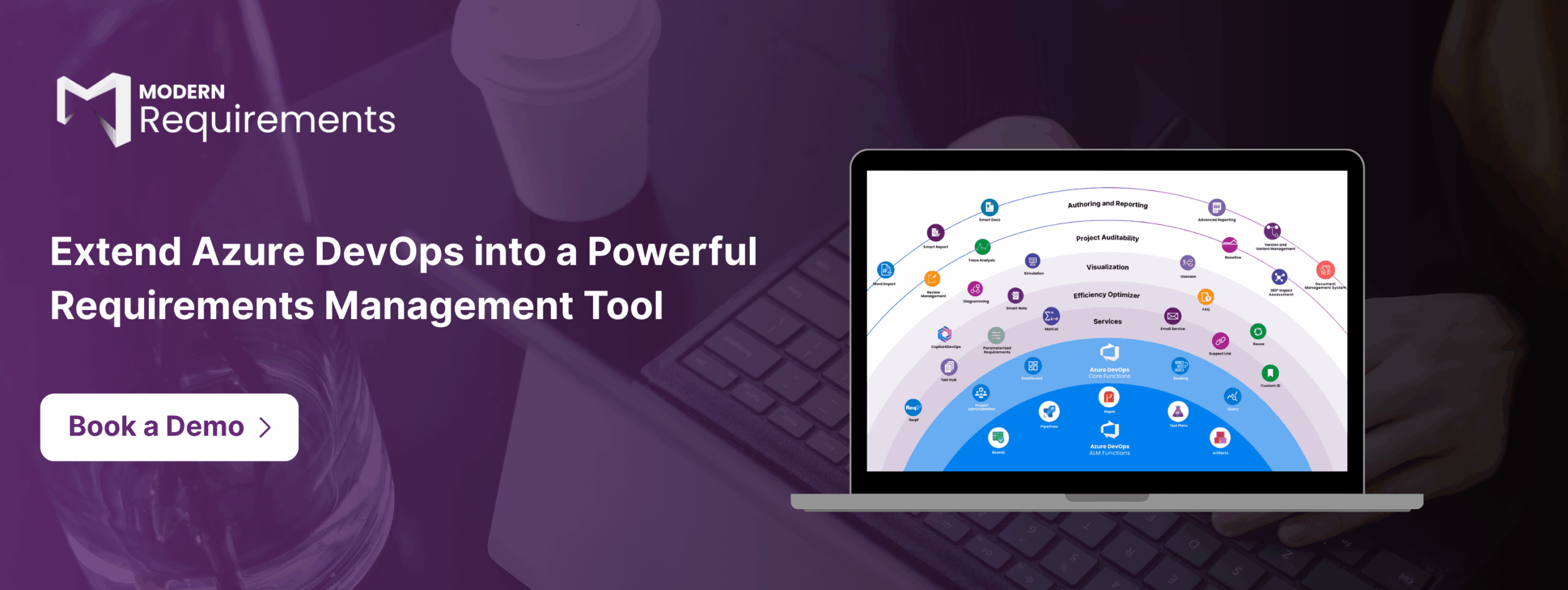
Modern Requirements4DevOps is built to manage compliance, such as NIST RMF, directly in Azure DevOps. Teams working in regulatory industries can store, manage, and link RMF security controls, development and test artifacts, logs, evidence, documentation, and reports all within Azure DevOps.
Then, using Modern Requirements4DevOps teams can create traceability matrices for specific work items to visualize their connectivity to each other. For example, teams can use:
AI capabilities further strengthen RMF alignment. Teams can use Copilot4DevOps:
To use AI for generating security requirements that align with NIST RMF controls.
By using the review module, the compliance management team can collaboratively validate that the final IT system’s security aligns with RMF controls and has been developed as intended.
✅ Define, manage, and trace requirements within Azure DevOps
✅ Collaborate seamlessly across regulated teams
✅ Get started for FREE—no credit card required
A deep dive into BABOK strategy analysis. Covers current state...
Learn how to write clear, testable requirements that prevent project...
Automate EU MDR technical documentation and GSPR traceability for medical...
End-to-end requirements management in Azure DevOps.
AI-powered assistance for DevOps workflows.
Autonomous AI agents for DevOps execution.
Real-time data sync across tools and systems.
Designed to work natively within Azure DevOps, Modern Requirements extends the platform with powerful capabilities that help teams capture, manage, and validate requirements more effectively.