

What is a Compliance Management System?
Learn more about what a compliance management system is, examples...

In your organization, have you ever heard someone saying, “We didn’t get updates,” or “No one has informed us about the change”? It’s a common situation in product development, where a change is made during the design phase, but no one tells the production side. Testing continues with outdated inputs. By the time someone notices, work has already moved forward in the wrong direction.
It’s not just a communication gap. It’s a visibility problem. Most companies, whether in manufacturing, aviation, healthcare, or engineering, continue to operate in disconnected systems. Each department uses its own tools, files, and methods. And when things don’t sync up, errors slip through unnoticed.
A digital thread solves this. It connects every step, from planning to delivery, so teams can see how one change affects everything else.
In this blog, we’ll break down what a digital thread really means, how it’s different from a digital twin, where it fits in across industries, and how tools like Modern Requirements help build it with less friction.
A digital thread is a concept or approach that connects the information of every stage of the product life cycle, from planning and manufacturing to launching, maintenance, and beyond. It stores all records of actions taken, changes made, tests conducted, maintenance performed, and decisions made throughout the product lifecycle.
You don’t install a “digital thread” like you install an app. Instead, teams build it by connecting their existing data and tools. That might include requirement documents, CAD models, test cases, code commits, review logs, and customer feedback, all tied together with traceable links.
The idea of the digital thread was introduced by the manufacturing and aerospace industries, where losing track of small changes can lead to huge disasters. Nowadays, the digital thread concept is used across multiple industries, including healthcare, software development, automotive, defense, etc.
In simple words, a digital thread is a connected data flow. The end goal of the digital thread is to allow teams to track what changed, when it changed, and how that change affected everything else.
Let’s pause on a quick fact: According to the RC-1137 report released by dimensionalmarketresearch.com, the global digital thread market size was $12.8 billion in 2024 and is expected to reach $78.4 billion by 2033.
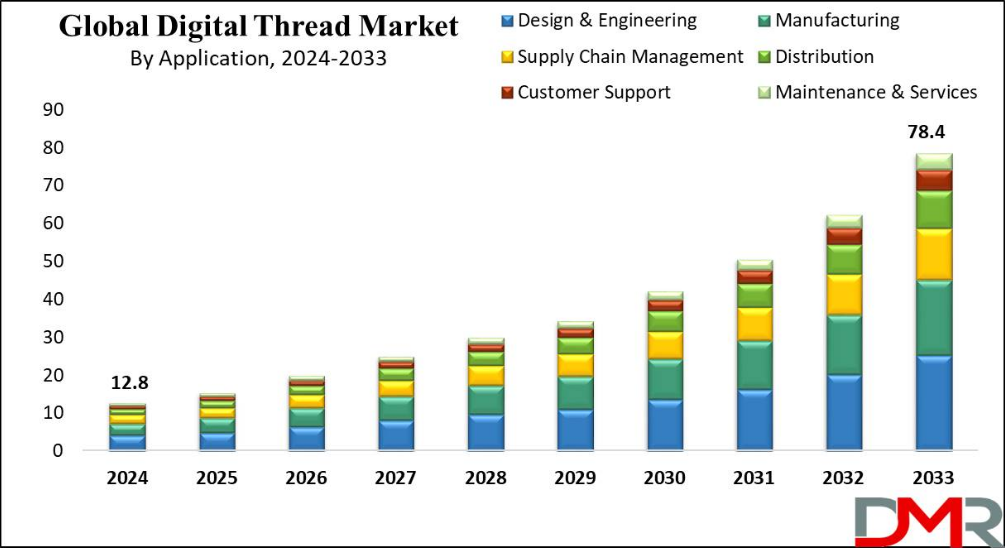
A digital thread connects all your product lifecycle data. So, it plays an important role in finding the root cause of errors, making changes traceable, and saving costs. Here, we have listed key benefits of using the digital thread in the product development workflow:
A digital twin is a virtual replica of a physical object that helps teams simulate the behavior of the system in real time. It uses real-world inputs, such as data from IoT sensors or software logs, to monitor system behavior, test changes, or spot problems early. It is often used in factories, smart buildings, or aircraft engines. For instance, the digital twin of the airplane simulates how changing the speed of the airplane can affect its fuel economy.

Area | Digital Thread | Digital Twin |
|---|---|---|
What it Means | A way to keep different types of data connected as the work moves from one stage to another. | A running digital model that shows what’s going on with a product or system in the real world. |
Main Use | Helps teams keep track of what changed, who did it, and what it touched. | Let’s engineers or operators see how something is performing right now, without taking it apart. |
Kind of Data | Project records, specs, review comments, test logs, etc., all the stuff that builds up during delivery. | Mostly live readings, events, and usage data pulled from machines, devices, or tools. |
Why it’s Used | Useful for companies building a digital thread strategy to improve handoffs, avoid rework, and meet standards. | Helps with monitoring, diagnostics, and real-time decisions. |
Technologies Involved | Built using digital thread technologies like PLM systems, requirement tools, version control, etc. | Depends on IoT platforms, analytics engines, and simulation tools. |
Role in Modern Work | Keeps the pieces organized during digital transformation, especially when teams work across locations or disciplines. | Adds visibility once a product is live or deployed in the field. |
A press release published on aras.com says that 89% of industrial companies recognize that digital thread is essential to success. This means it is mainly used within all types of manufacturing companies.
Here are some real-world use cases of the digital thread in different industries:
Let’s say you are doing the inspection of an aircraft and find there is a fault in the autopilot feature. With the digital thread in place, rather than digging through scattered documents, emails, and other records, the inspection team can trace every related detail, including the original requirements, software logic, tests, and who conducted the final review. This speeds up the fault-finding process.
Medical devices are highly regulated products, and teams need to make proper documentation and reports to get approval from regulatory bodies like the FDA. A digital thread brings all data, including requirements, tests, change updates, verification records, review history, etc., in one place, making it easier for compliance teams to prepare reports for product submission. Furthermore, as everything, from design intent to production logs, is already connected and time-stamped, it becomes far easier to prove that procedures were followed and safety requirements met.
Automotive manufacturing depends on a long chain of suppliers, including electronics, metal parts, interior modules, software units, and more. When a new design for any part is introduced, the change must reach the right vendors, and the digital thread exactly helps with that. For instance, when a new layout of the car dashboard is approved, the supplier should get the right version tied to the correct build numbers and assembly instructions. This reduces the chances of miscommunication.
A digital thread concept is not only about having a single source of truth for all files and information; every knowledge base software offers that for free. But it’s also about connecting all related work items to make them traceable, making work item reviews easier, and so on. And this is where most ALM tools fall short. You can create tasks in Jira or ClickUp, but when it comes to full traceability across requirements, tests, risks, and reviews, things fall apart.
Modern Requirements4DevOps solves this by working natively inside Azure DevOps. No sync tools. No exports. Just everything in one place, always connected.
Key features that support digital thread strategies include:

Unlike generic tools, Modern Requirements is purpose-built for industries where decisions must be backed by clear, traceable evidence.
Not at all. Smaller companies also deal with design changes, missed handoffs, or unclear version histories. So, they can also use a digital thread.
The biggest hurdle is fragmentation. Teams often use various tools for managing documents, requirements, reviewing, diagramming, etc. Getting those systems to stay connected is tough without help from proper digital thread technologies.
It works directly inside Azure DevOps, linking every part of the lifecycle without relying on third-party tools.

✅ Define, manage, and trace requirements within Azure DevOps
✅ Collaborate seamlessly across regulated teams
✅ Get started for FREE—no credit card required
Learn more about what a compliance management system is, examples...
Learn more about the ISO13489 compliance, its importance and its...
Learn more about what requirements versioning is, its importance in...