
SysML and Requirements Traceability: Linking Model Elements to Managed Requirements
Learn how SysML links requirements to design and verification through...

If you work in business analysis, you have probably heard of BABOK. The Guide to the Business Analysis Body of Knowledge, published by the International Institute of Business Analysis (IIBA), defines what business analysts do, how they do it, and what skills they need to do it well.
The BABOK is not a project management methodology or a step-by-step process. It is a framework that organizes business analysis work into six knowledge areas, each covering a different dimension of the BA role. Whether you are preparing for CBAP certification, building a BA practice from scratch, or trying to make sense of requirements on a messy project, understanding these six knowledge areas gives you a map.
This blog breaks down all six, covers the key tasks within each, and shows how they connect to the work of managing requirements in practice.
Before diving into the knowledge areas, it helps to understand the foundation. BABOK v3 introduced the Business Analysis Core Concept Model (BACCM), which identifies six interrelated concepts that underpin all business analysis work:
Business analysis is the practice of enabling change in an enterprise by defining needs and recommending solutions that deliver value to stakeholders. (IIBA, BABOK v3)
These six concepts show up everywhere across the knowledge areas. When you understand them, you start to see how the six knowledge areas are not isolated disciplines. They are connected dimensions of the same work.
The IIBA also defines what a requirement is in BABOK v3: a usable representation of a need. That is intentionally broad. It may be a user story, a business rule, a data model, or a process diagram. Whatever form it takes, it captures something that someone needs and is usable enough to act on.
The six knowledge areas of BABOK are organized around distinct phases and activities in business analysis. They are not strictly sequential. On any real project, several knowledge areas will be active at the same time. But understanding each on its own terms is the starting point.
Before you gather a single requirement, you need a plan.
This knowledge area covers how business analysts organize and coordinate their work. It is where the BA decides how to approach the project, who needs to be involved, how changes to requirements will be managed, and how the overall BA effort will be tracked and improved.
Planning a business analysis effort is much more than scheduling interviews and workshops. It involves a series of interconnected decisions that shape the entire project.
One of the first decisions is how the project will be run. The BA must evaluate three primary approaches:
The right choice depends on the organization, the stakeholders, the problem domain, and the risk tolerance of the project. Most real-world projects use elements of all three.
Identifying stakeholders is one of the most important and most underestimated tasks in business analysis. Miss a key stakeholder early and you will find out about their requirements late, usually when the cost of change is highest.
BABOK identifies several dimensions of stakeholder analysis, including whether users are experienced or novice, full-time or part-time, internal or external, and whether there are language or cultural differences to account for. Each of these dimensions affects how requirements will be gathered from them and how information will be communicated back.
Once stakeholders are identified, a communication plan must be established. Different stakeholders need different information in different formats. Executives may need a high-level summary. End users need to see prototypes and workflows. Developers need precise functional specifications.
Planning business analysis governance means deciding how decisions will be made, how conflicts between requirements will be resolved, and who has authority to approve changes. This is critical. Without a clear governance structure, requirements discussions can turn into political battles with no resolution.
Planning information management covers how requirements will be stored, traced, and maintained throughout the project. This includes decisions about tools, document formats, naming conventions, and access controls.
The BA plan should include a requirements risk plan. The BABOK identifies a five-step approach to managing risk in the analysis phase: developing the risk management approach, identifying risks, assessing risks, responding to risks, and monitoring and controlling risks throughout.
There are four classic responses to any identified risk: avoid it, mitigate it, transfer it, or accept it. In most cases, the response will be a combination. Responding to one risk often creates new risks, which is why risk management is an ongoing activity rather than a one-time exercise at the start of the project.
The person with the most facts wins the negotiation. A gut-feel estimate will not be very credible with stakeholders. A step-by-step plan with assumptions and supporting data will be impressive.
Getting requirements out of people’s heads and onto paper.
This knowledge area covers the techniques business analysts use to discover, extract, and confirm requirements from stakeholders. It also covers the ongoing communication with stakeholders after requirements are elicited. The IIBA identifies five core tasks: prepare for elicitation, conduct elicitation, confirm results, communicate business analysis information, and manage stakeholder collaboration.
The biggest driver when selecting an elicitation technique is the customer. Before choosing, the BA must analyze the situation across three main dimensions:
| Technique | Best Used When | Key Advantage | Watch Out For |
|---|---|---|---|
| Customer Interviews | All situations; often combined with other techniques | Deep exploration, flexible | Time consuming at scale |
| Job Shadowing / Observation | User requirements, BA new to domain, users not experienced with systems | See what users actually do vs. what they say they do | Hawthorne effect: people behave differently when observed |
| Studying Existing Systems | Technology change with stable business process; understanding as-is | Jumpstarts with existing documentation | Docs may be outdated or not reflect actual practice |
| Interface Analysis | Understanding system dependencies and big-picture impact | Reveals hidden integration requirements | Easy to leave until too late; should be done early |
| Surveys | Large or geographically dispersed populations | Reaches many people quickly | Response rates; can't probe unclear answers |
| JAD / Facilitated Sessions | Multi-stakeholder environment; consensus building needed | Surfaces conflicts and resolves them in real time | High risk; requires significant planning and commitment |
| Focus Groups | Early phase; gathering ideas without committing to implementation | Many ideas without resource commitment | Set realistic expectations upfront |
| Market Research | Early research; evaluating what is available on the market | Leverages existing solutions and market intelligence | May limit creativity or anchor thinking too early |
| Benchmarking | Evaluating competition or industry best practices | Grounds requirements in real-world standards | Information may be difficult to obtain |
| Prototyping | Reducing abstractness; bridging language gaps; throughout the process | Makes requirements concrete and reviewable | Risk of stakeholders expecting the prototype to become the product |
| Storyboarding | Communicating in customer language; reducing abstractness | Shows 'what' without going into 'how' | Less detailed than full prototyping |
| Brainstorming | Early stages; generating a large number of ideas quickly | Surfaces ideas that structured techniques miss | Easy to lose focus; needs strong facilitation |
The key insight from BABOK on elicitation is that no single technique is right for all situations. The business analyst’s job is not to have a favorite technique but to select the right tool for the specific stakeholder, category, and context of each project. Think of these techniques as a toolbox, not a checklist.
Once requirements are elicited and documented, they must be confirmed. This means reviewing the captured requirements with stakeholders to ensure that the BA’s understanding matches their actual needs. Eliciting and confirming are two separate steps. Skipping confirmation is one of the most common causes of late-stage surprises.
Requirements do not end when they are written.
This knowledge area covers how requirements and design information are maintained and controlled throughout the project. Requirements are living artifacts. They get updated, challenged, prioritized, traced, and approved. This knowledge area provides the discipline to manage all of that without losing control of what was agreed.
Once requirements are elicited and documented, they enter a lifecycle. That lifecycle has several distinct stages, each requiring active management:
The purpose of requirements management is to manage the requirements of the project’s products and product components and to identify inconsistencies between those requirements and the project’s plans and work products. (SEI-CMMI)
The SEI-CMMI perspective reinforces BABOK here: unless there is a formal approach to getting buy-in and reviewing requirements with key stakeholders, there is not much point in formalizing the process for capturing them. Most organizations spend far more effort on eliciting requirements than on validating them, which is the wrong balance.
Before fixing the system, understand the business.
Strategy analysis is where business analysts zoom out from individual requirements to understand the broader context in which the project operates. A project does not exist in a vacuum. It exists within a business, which has goals, policies, rules, and relationships with the outside world. Understanding all of that is what makes the difference between a BA who delivers features and one who solves business problems.
Before defining where the business needs to go, the BA must understand where it is. This as-is analysis includes documenting the business architecture, which captures what the business does, how it does it, where it operates, who is involved, what events trigger activities, and why those activities exist.
One widely used framework for this is the Zachman Framework for Enterprise Architecture, which maps six views of the business (what, how, where, who, when, and why) against five perspectives (planner, business model, system model, technology model, and builder). While the framework itself is complex, the underlying principle is straightforward: the business analyst must understand the enterprise before recommending changes to it.
Strategy analysis also involves understanding business rules, policies, procedures, and competencies. These are not requirements themselves, but they are the context within which requirements are gathered. A business rule like ‘the pharmacist must check for drug interactions before filling a prescription’ raises a set of questions that drive requirement definition: Should this be automated? What information is needed? What happens if a problem is found?
Once the current state is understood, the BA helps define what the business needs to look like after the project is complete. This involves setting clear business goals and objectives, capturing assumptions, documenting constraints, and writing a scope statement.
The scope statement defines what is included in the project and what is not. System scope is like a hole, perhaps defined by what it is not, rather than what it is. A well-defined scope prevents the continuous evaluation of what is inside versus outside the project boundaries that plagues so many initiatives. It is the foundation for avoiding scope creep later on.
The BA must identify all organizations, systems, and external entities that will interact with the solution. A context diagram (sometimes called a level 0 data flow diagram) is a useful tool for this. It shows the scope area at the center, external entities as rectangles, and data flows as arrows between them.
This exercise is important because system interfaces often represent the majority of a project’s budget, yet they are frequently underestimated or identified too late. Communicating the full scope of interfaces to customers helps set accurate expectations about why development takes as long as it does.
Strategy analysis includes evaluating whether the project is worth doing at all, and if so, how. A feasibility study is a project in itself. It should have requirements, deliverables, and a project plan. The key steps are: identify the problem or opportunity, understand the current situation, define a vision of the solution, determine alternative solutions, and recommend a solution.
The business case makes the financial and strategic argument for the project. It compares costs and benefits, accounts for timing (when costs occur versus when benefits are realized), and evaluates both quantitative and qualitative factors. Good business cases are honest about uncertainty. Numbers that are solid should be presented with confidence. Numbers that are estimates should be clearly labeled as such.
A very good project manager who does not understand the business goals can very effectively deliver the wrong product.
Turning raw requirements into a coherent, prioritized, verifiable specification.
This knowledge area covers what happens after requirements are elicited. The raw material gathered through interviews, workshops, and observation must be organized, analyzed, modeled, verified, and validated before it is ready for development. This is where many projects lose discipline, moving from ‘we talked to stakeholders’ to ‘here is the design’ without the rigorous middle step.
Requirements gathered from multiple stakeholders across multiple sessions will arrive in a disorganized state. The BA’s job is to organize them into a coherent structure that reflects how the system will actually work.
Requirements can be structured in several ways: by user type, by business process, by functional area, or by use case. The right structure depends on the project. What matters is that the structure is logical, navigable, and reflects the way stakeholders think about their work. A medium-sized project typically demands hundreds of requirements. Readers can only understand these fully when the requirements document is organized logically.
Models are visual or structured representations of requirements that communicate information more efficiently than text alone. Different models serve different purposes:
No single model is sufficient for a complex system. Models complement text-based requirements. They catch different categories of errors and communicate different aspects of the business problem.
Verification asks: does the requirement meet the quality criteria for a good requirement? Is it clear, complete, consistent, and testable? Validation asks: does the requirement actually reflect what the stakeholder needs? Both are essential, and they are different activities.
A requirement can pass verification and still fail validation. It can be perfectly written and completely wrong. Validation requires getting the requirements in front of stakeholders in a form they can review and comment on.
Not all requirements have equal value or equal urgency. Prioritization is a facilitated process, not a technical one. The BA organizes and facilitates the discussion, but the business must make the decisions. Common prioritization approaches include MoSCoW (Must have, Should have, Could have, Will not have this time), forced-pair ranking, and weighted scoring.
Sequencing looks at dependencies between requirements. Some requirements cannot be implemented until others are complete. Others can be implemented in parallel. Getting the sequence right reduces rework and helps the team deliver value earlier.
Did the solution actually solve the problem?
This knowledge area covers the BA’s role in verifying that what has been built matches what was required, and that what was required actually solves the original business problem. It is the closing of the loop that started with strategy analysis. Too often, solution evaluation is treated as an afterthought. BABOK treats it as a full knowledge area because it is.
Once a solution is implemented, its performance must be evaluated against the original requirements. This is not the same as testing. Testing verifies that the system does what it is supposed to do. Solution evaluation asks whether what it is supposed to do actually solves the business problem.
A system can pass every test case and still fail to deliver the expected business value. This happens when requirements were technically correct but did not capture the real business need, or when the business environment changed between the time requirements were written and the time the solution was deployed.
Validation at the solution level means checking that stakeholders are satisfied with the delivered product. This includes user acceptance testing, but it goes beyond it. The BA must assess whether the business objectives that justified the project have been met or are on track to be met.
Where gaps exist between expected and actual performance, the BA must determine whether the gap is due to a defect in the solution, an incomplete requirement, a change in the business environment, or an unrealistic expectation. Each of these diagnoses leads to a different response.
When a solution falls short of expectations, the BA’s job is not just to document the gap but to recommend what to do about it. This might mean recommending changes to the solution, changes to the business process, additional training for users, or adjustments to expectations. In some cases, the recommendation may be that no further action is warranted.
On paper, the six knowledge areas can seem sequential: plan, elicit, manage, analyze, define, evaluate. In practice, they are concurrent and iterative. On any active project, a BA might be managing requirement changes (lifecycle management) while simultaneously eliciting requirements from new stakeholders (elicitation) while also reviewing the solution architecture against the requirements analysis.
What the six knowledge areas provide is a mental model for the full scope of business analysis work. They prevent the common failure mode where a BA treats elicitation as the whole job, spending all their time in interviews and workshops while neglecting planning, lifecycle management, and solution evaluation.
| Knowledge Area | Core Question It Answers | Key Risk If Neglected |
|---|---|---|
| BA Planning and Monitoring | How will we manage this analysis effort? | Uncoordinated work, missed stakeholders, no change control |
| Elicitation and Collaboration | How do we get requirements out of stakeholders? | Wrong or incomplete requirements from the start |
| Requirements Lifecycle Management | How do we keep requirements accurate and controlled? | Requirements drift, untraceable changes, failed audits |
| Strategy Analysis | Does this project address the right business problem? | Building a perfect solution to the wrong problem |
| Requirements Analysis and Design Definition | Are our requirements complete, correct, and ready to build? | Ambiguous requirements, rework, late-stage surprises |
| Solution Evaluation | Did the solution actually solve the business problem? | Delivered systems that pass testing but fail to deliver value |
Understanding the six knowledge areas is one thing. Operationalizing them across a real project with real stakeholders, real deadlines, and real constraints is another. This is where tooling becomes critical.
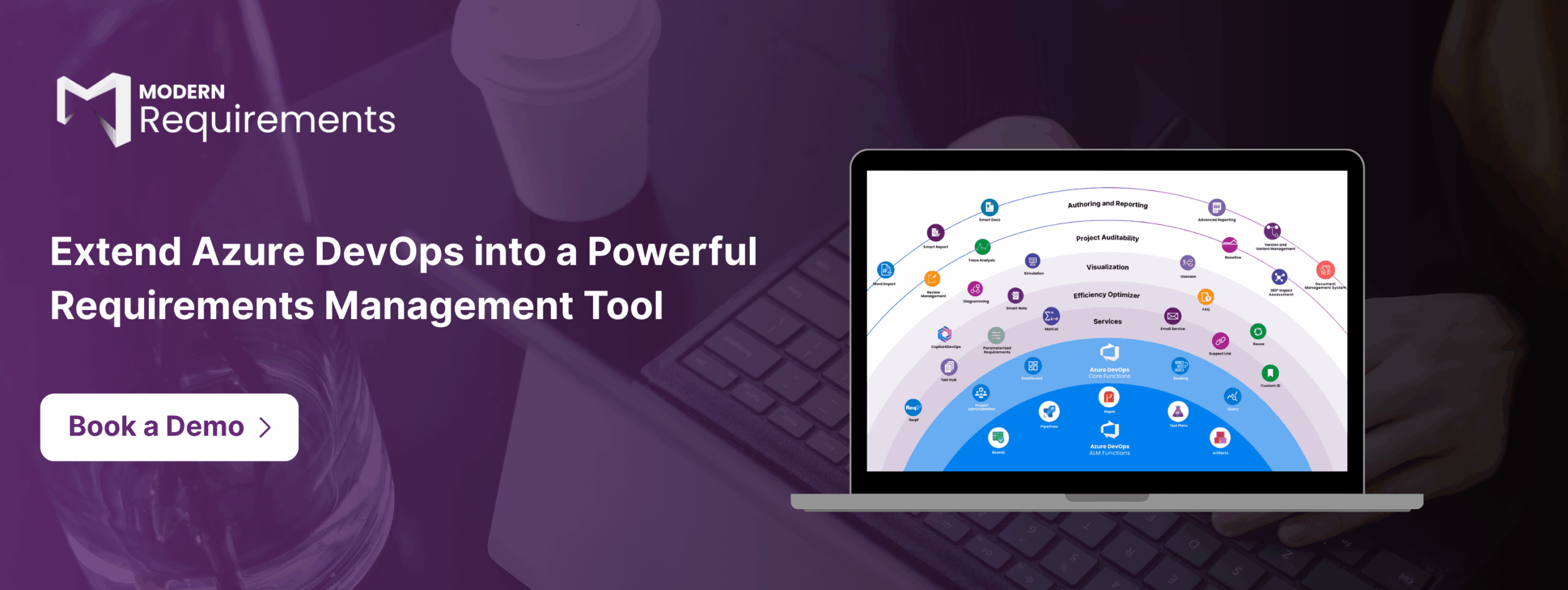
Modern Requirements is built natively into Azure DevOps and supports all six BABOK knowledge areas in practice:
The BABOK provides the framework. Modern Requirements provides the infrastructure to put that framework to work in the environment where most enterprise development teams already operate.
✅ Define, manage, and trace requirements within Azure DevOps
✅ Collaborate seamlessly across regulated teams
✅ Get started for FREE—no credit card required
Learn how SysML links requirements to design and verification through...
Manage and organize software requirements efficiently with Azure DevOps and...
ISO 24089 governs automotive software update engineering and supports UNECE...

End-to-end requirements management in Azure DevOps.

AI-powered assistance for DevOps workflows.

Autonomous AI agents for DevOps execution.

Compliance management, built into Azure DevOps.

Real-time data sync across tools and systems.