Skip to content

SysML and Requirements Traceability: Linking Model Elements to Managed Requirements

Listen to this blog

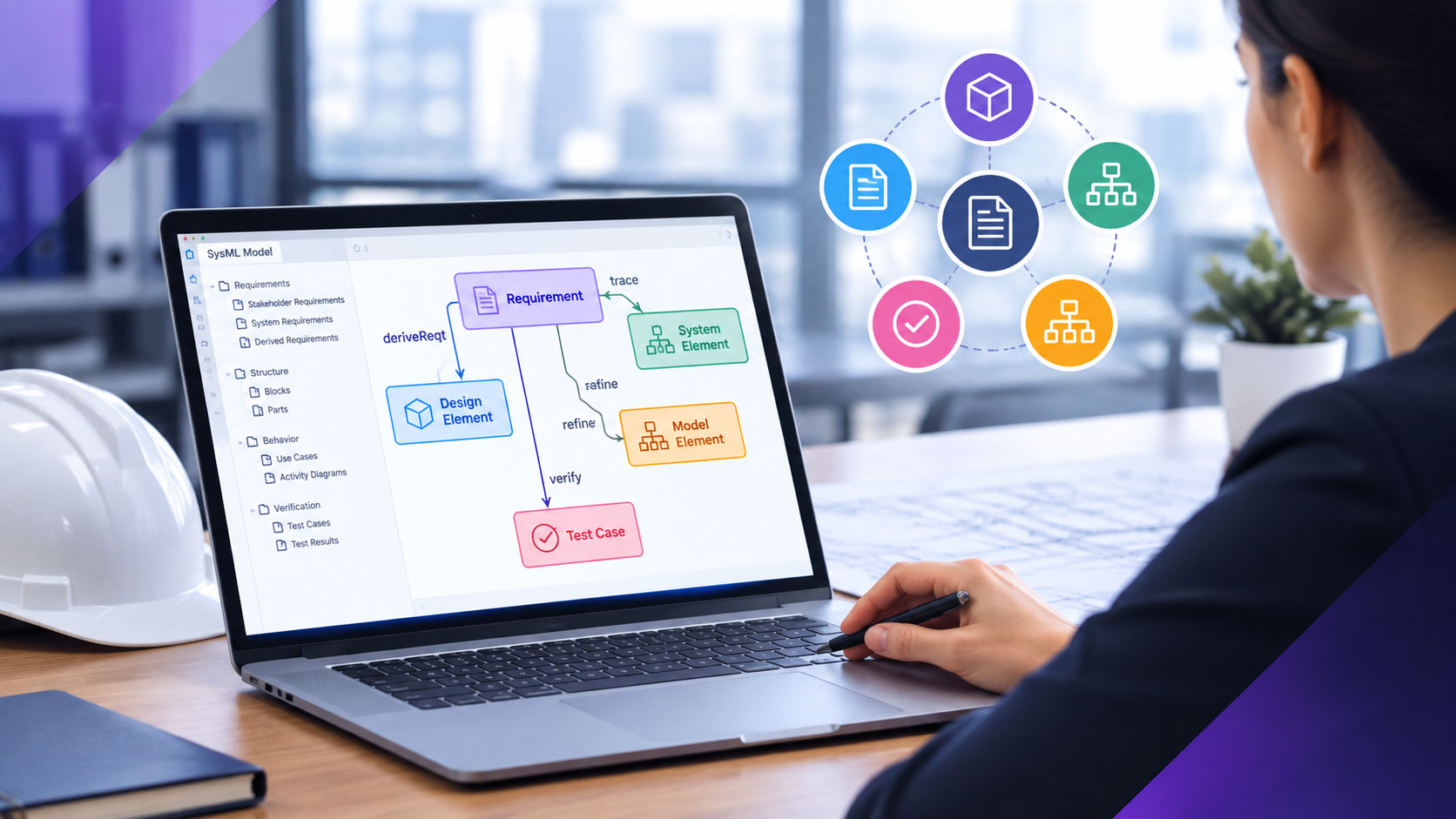
SysML requirements traceability refers to how requirements are connected to other requirements, system elements, and verification elements within a SysML model. Relationships such as deriveReqt, satisfy, verify, refine, and trace give these connections specific meaning, helping engineers follow a requirement from its origin through system design and verification.

Key Takeaways

What you’ll learn in this article

  • SysML traceability connects requirements to design and verification through five relationshipssatisfy, derive (deriveReqt), verify, refine, and trace — each giving a link a specific meaning.

  • Model-based traceability powers impact analysis: when a requirement changes, existing links reveal the affected design elements, derived requirements, interfaces, and verification cases — and traceability matrices keep this manageable at scale.

  • SysML v2 (official OMG spec, September 2025) models requirements as constraints with a definition-vs-usage approach and a KerML-based standard API for tool interoperability — though many teams still run v1.6 and v1.7.

  • SysML shows how requirements relate, but not how to manage them — version history, baselines, reviews, approvals, and reporting need a managed requirements layer, especially when requirements sprawl across models, spreadsheets, and documents.

  • Pairing SysML with a managed repository like Modern Requirements4DevOps in Azure DevOps creates a digital thread: SysML holds the engineering relationships while MR4DevOps handles traceability matrices, baselines, reviews, and coverage.

Want to connect SysML traceability with managed requirements in Azure DevOps? Get a Demo

As systems become more complex across aerospace, defense, automotive, rail, and medical-device industries, structured traceability helps teams assess requirement changes, identify affected system elements, and confirm that requirements have corresponding design and verification links.

SysML, an OMG standard for Model-Based Systems Engineering (MBSE), provides these standardized relationships. SysML v2 requirements go beyond this, with stronger semantics, requirement definition vs usage, and a standard API for better tool interoperability.”

This guide explains SysML requirement relationships, traceability challenges, SysML v2 improvements, and how managed requirements solutions support MBSE workflows.

The Five SysML Requirement Relationships

SysML requirements traceability is defined by five types of relationships between requirements and engineering artifacts, thus establishing explicit links between stakeholder requirements, system design, and verification activities.

Relationship
What it Links
Traceability Meaning
Satisfy «satisfy»
Design element Requirement
Shows that a design element fulfils a specific requirement.
Derive «deriveReqt»
Requirement Requirement
Creates lower-level requirements from higher-level stakeholder requirements.
Verify «verify»
Test case Requirement
Confirms that a requirement has been validated through testing, inspection, or analysis.
Refine «refine»
Model element Requirement
Adds technical detail or clarification to a requirement without changing its intent.
Trace «trace»
Any element Requirement
Provides a general relationship when no more specific relationship applies.

These kinds of relationships provide engineers the ability to move through the model in both directions, identifying elements that meet a particular requirement and the requirements that support a particular element of the system.

How Traceability Actually Works Inside a SysML Model

In SysML Traceability, there is a well-defined association between requirements and engineering artifacts through the life cycle of the system. SysML does not take requirements in isolation but instead makes associations among requirements and structures, behavior, interfaces, allocations, and verification.

These relationships can be represented through SysML requirement diagrams. Diagrams become unwieldy with larger systems. MBSE tools use  SysML traceability matrices and table-based views to help engineers review connections between requirements and related artifacts.

A traceability matrix helps teams to identify:

  • Design features conforming to the requirements
  • Subject to requirements verification.
  • Trace links missing
  • Requirements for some components
SysML traceability matrix showing design, verification, missing links, and component requirements
A SysML traceability matrix helps identify design features, verification subjects, missing trace links, and component requirements.

These views are valuable during design reviews, safety assessments, and certification activities where teams must demonstrate complete requirement coverage.

Supporting Impact Analysis

A major benefit of model-based traceability is understanding the impact of requirement changes. When a requirement is changed, the existing model relations allow the engineers to trace the design elements, behavioral models, interfaces, derived requirements, and verification activities affected by the requirement change.

SysML allocation relationships also connect system behaviour with physical architecture, keeping requirements, design, and verification aligned throughout development.

Common SysML Traceability Challenges

Although SysML provides strong modelling relationships, maintaining accurate traceability becomes more challenging as systems grow and teams become distributed.

When requirements are kept in spreadsheets or other disconnected tools, updates to requirements may not be reflected in the SysML model, design artifacts, and verification 

activities. It could result in broken trace links, version inconsistency, and problems with impact analysis.

Common challenges include:

  • Tracing relationships between large numbers of requirements and system components.
  • Evaluating the effect of requirement changes on multiple sub-systems.
  • Maintaining complete verification and compliance evidence.
  • Supporting collaboration when engineering and review teams use different tools.
Common SysML traceability challenges in requirements management
Common SysML traceability challenges include tracing relationships, evaluating requirement changes, maintaining verification evidence, and supporting collaboration across different tools.

Such challenges illustrate the difference between system modeling and requirements management. SysML specifies engineering relationships. Managed requirement solutions support controlling the requirement lifecycle at scale.

What Changes in SysML v2

The release of SysML v2 as an official OMG specification in September 2025 introduced improvements that strengthen MBSE and requirements traceability.

SysML v2 models requirements as system constraints and is a clear requirement definition vs usage approach. That means an engineer defines a requirement once and can reuse it in different models. Built on the KerML metamodel, it also provides a standardized API for better interoperability between modelling tools and managed requirements platforms.

Although SysML v2 is the current standard, adoption is still evolving. Many organizations continue using SysML v1.6 and v1.7, where relationships such as satisfy, deriveReqt, verify, refine, and trace remain essential for traceability.

Where Model-Based Traceability Reaches Its Limits

A SysML model can show how a requirement relates to the system being designed. An engineer can see which model element satisfies a requirement, which requirement was derived from another, and which element is used for verification. That gives the team a useful view of the engineering logic behind the system.

The challenge starts when the requirement set becomes large and changes over time. A real project may contain requirements at stakeholder, system, subsystem, and component levels. Engineers may also need to maintain different versions and baselines as the system develops. At that point, knowing how requirements are connected is only part of the problem. The team also needs to control the requirements themselves.

This becomes harder when the requirement information is spread across the SysML model, spreadsheets, documents, or other engineering tools. A requirement may change in one place while its related information remains unchanged somewhere else. Engineers then have to check whether the change affects a model element, a derived requirement, or a verification case. The relationships may exist, but they are harder to maintain when the underlying information is split across systems.

There is also a difference between tracing a requirement and managing it. SysML can represent the relationship between a requirement and the engineering elements connected to it. Requirements management covers the broader work of maintaining the requirement set as it changes, including version history, baselines, reviews, approvals, and reporting.

This is why SysML and requirements management are often used together. The SysML model provides the engineering context and relationships, while a managed requirements repository provides a controlled source for the requirements. When these systems are connected, teams can maintain the requirement itself while still tracing how it moves through system design and verification.

Connecting SysML to Managed Requirements in Azure DevOps

Many engineering organizations use a connected approach instead of replacing SysML or requirements management tools. In this process, the SysML model takes care of engineering relationships such as requirements derivation, satisfaction, refinement, and validation, whereas the managed requirements repository handles reviews, approvals, baselines, reporting, and requirements change.

If you are a team using Azure DevOps, Modern Requirements4DevOps provides this managed requirements layer by using Azure DevOps native work items. It allows creating traceability matrices for SysML requirements and visualizing how these requirements are connected with the evidence that proves the requirement was implemented and followed. Additionally, it also supports capabilities such as baselining, review management, and coverage analysis without leaving Azure DevOps.

As a whole, they form a digital thread that will help to keep all of those things synchronized for the entirety of the system lifecycle.

Frequently Asked Questions

What is SysML requirements traceability?

This is the ability to relate requirements to model elements that satisfy, derive, verify, refine, or trace those requirements.

What's new about SysML v2?

SysML v2 includes other features such as requirements specification and usage, enhanced semantics with KerML, and an API for improved interoperability of engineering tools

How do Modern Requirements4DevOps and SysML relate?

SysML models system requirements and their relationships to design and verification. Modern Requirements4DevOps manages those requirements in Azure DevOps, including traceability, reviews, baselines, and changes.

Start using Modern Requirements today

✅ Define, manage, and trace requirements within Azure DevOps
✅ Collaborate seamlessly across regulated teams
✅ Get started for FREE—no credit card required

Recent Articles

Modern Requirements logo mark