Here is a reality of requirements management nobody talks about: 66% of organizations report project delays due to unclear or vague requirements (one of the common risks associated with requirements).
Furthermore, A recent academic study performed on 99 projects found that 78% of projects experienced time overruns and 58% experienced cost overruns.
What’s the real culprit here? Mismanaged requirements risks that nobody saw coming.
Requirements risk management flips this script entirely. It helps identify and address problems and risks before they derail everything. Even PWC’s global risk survey states that organizations that implement risk management are five times more likely to deliver stakeholder confidence and business outcomes.
Let’s understand risk management in requirements engineering, a step-by-step process, different types of requirements risks, and how modern tools can help with the same.
What Does Requirements Risk Management Mean?
Requirements risk analysis or management is the discipline of identifying, evaluating, and mitigating risks associated with existing requirements that can negatively impact the project. It spots trouble hidden inside requirements before it spreads into design, code, and testing.
This approach focuses on identifying unclear, missing, conflicting, or unrealistic requirements and evaluating their potential consequences on the project. Other than that, it also enforces teams to develop and implement risk measurement controls to mitigate risks.
It treats requirements as risk sources, not just project inputs. Teams question assumptions, check clarity, test feasibility, and confirm that each need can actually be verified.
The purpose is simple. Reduce rework, improve decision-making, avoid late surprises, and keep operations stable by fixing problems where they start.
In short, requirements risk management provides an early control over uncertainty that lives inside requirements.
Common Types of Requirements Risks and Ways to Handle Them
Before we understand the requirements risk management process, let’s understand the common types of requirements risks and how to neutralize them:
1. Incomplete or Missing Requirements
When the product requirements document contains a happy path to implement the system, but ignores edge cases, error scenarios, or integration points.
- Example: An e-commerce checkout system has detailed requirements to implement a payment gateway, but has no clue about handling failed transactions or partial refunds.
Mitigation tip: Run “what if” sessions with your team. Challenge every requirement with failure scenarios. Use requirement completeness checklists that force you to address security, performance, error handling, and edge cases upfront.
2. Vague or Non-Testable Requirements
If requirements use fuzzy language that every team member interprets differently, it is called vague requirements.
- Example: The system should load quickly.
It doesn’t contain any clue about how many seconds the system should load or talk about any conditions. The complete version of the above requirement might be:
- The system should load in 3 seconds.
Mitigation tip: Instruct the team not to use subjective terms entirely. Replace every vague descriptor with measurable criteria.
3. External Dependency Risks
When any feature depends on a third-party API that changes without notice, it produces external dependency risks.
To mitigate external dependency risks, track them as risk items and maintain fallback options.
4. Compliance and Regulatory Risks
When requirements don’t follow regulatory guidelines, it produces compliance risks that can lead to hefty penalties and license suspension.
To avoid compliance risks, involve compliance experts early and map regulations directly to requirements. Also, use AI tools to continuously track updates in regulatory standards and implement them whenever they change.
5. Requirements Out of Sync
When the requirements document states one thing, user stories explain it in a different way, and test cases follow different steps, then teams work based on different understandings of the same feature. This introduces rework later that can lead to budget overruns and delays in project launch.
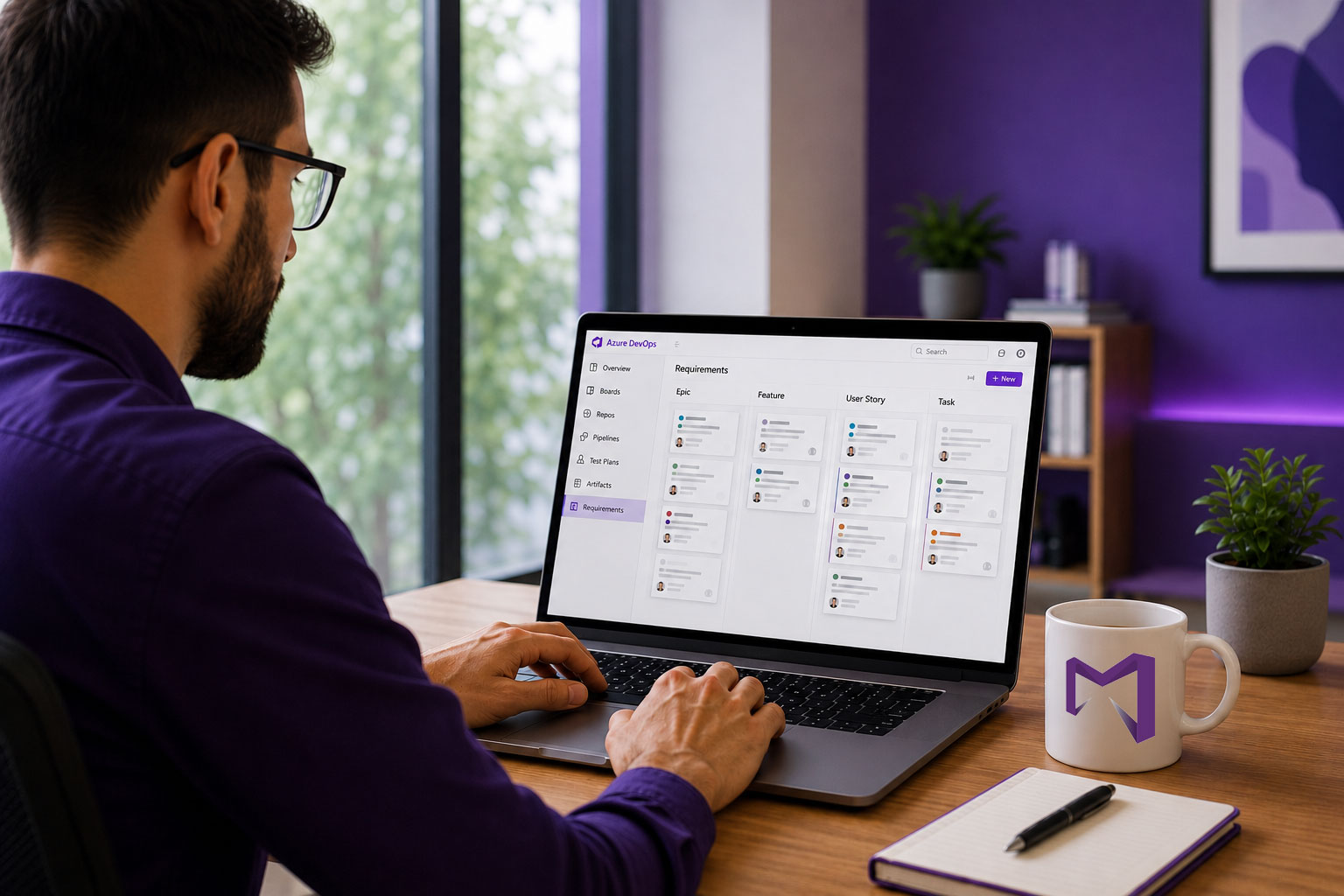
Tip to mitigate: Maintain a single source of truth and enforce version control. Teams can utilize tools like Azure DevOps for project and requirements management. Use trace links between requirements, design, and test artifacts so updates stay aligned across all project assets. Regular reviews help catch mismatches early.
The Requirements Risk Management Process
After reading the previous section, you already know what types of common requirements risk can appear and how to avoid them.
Furthermore, risk management is a continuous cycle that runs parallel to your entire project lifecycle, and you should understand the step-by-step process:
1. Identify Requirements Risks
The first step is assessing requirements quality and risks associated with them. Teams should find unclear statements, missing user needs, technical limits, or external rules that may affect delivery.
For this, you can gather cross-functional teams and run brainstorming sessions. A pointed question that might be asked: What assumptions are we making? Which stakeholders haven’t we talked to yet? Where are the knowledge gaps?
However, manually conducting this risk assessment can be difficult and time-consuming. Teams can use AI tools like Copilot4DevOps, which works within ADO, and allows teams to analyze requirements against different frameworks, such as INVEST, MoSCoW, PABLO Criteria, etc., and suggest a quality score with suggested improvements.
2. Analyze and Prioritize the Risks
Once risks and required improvements are identified, teams should list the impact of each work item.
Then, prioritize and fix high-impact risks first. Low-impact risks can be handled later.
3. Plan and Implement Risk Responses
Each important risk needs a clear action plan. This may involve rewriting the requirement, adding acceptance criteria, running technical validation, or clarifying stakeholder expectations.
Every action must have an owner and a timeline. Without responsibility, risks remain open.
4. Monitor and Review Continuously
As the project moves forward, requirements keep changing and introduce new risks. So, it is very important to continuously monitor and review requirements.
Regular reviews keep the risk list current. Teams check if earlier actions worked and adjust when needed.
5. Maintain Traceability
Each risk, requirement, and mitigation should stay connected. This creates visibility and helps teams prove control, especially in regulated environments. Furthermore, traceability ensures no risk-handling effort is lost over time.
Why Requirements Risk Management Needs the Right Tool
- Manual tracking fails at scale: If teams rely on spreadsheets, emails, and scattered documents for risk management, it breaks down when the project scales and cannot keep pace with frequent requirement changes.
- No clear traceability: Without links between requirements, risks, and tests, teams cannot see the impact of risk. Furthermore, one change might affect many areas.
- High cost of late risk discovery: When requirements risks are found during testing or after release, fixes require lots of rework across design and development. It might lead to budget overrun or project failure.
- Difficult compliance evidence: In regulated projects, missing history and approvals create stress during audits. Teams scramble to prove what was decided earlier.
How Modern Requirements4DevOps Strengthen Requirements Risk Management
Modern Requirements4DevOps strengthens requirements risk management by bringing structure directly into the team’s daily workflow. Instead of managing risks in separate tools, everything stays connected inside Azure DevOps, which reduces gaps and confusion.
The change impact assessment capabilities of Modern Requirements4DevOps allow teams to assess how changes might affect other project requirements. So, teams can address associated risks before making any changes.
Furthermore, with the Smart Docs feature, teams can create live-in requirements documents that update when any requirement updates. So, documents always stay updated, and risks associated with outdated documents can be overcome.
Additionally, Modern Requirements4DevOps allows creating horizontal and intersection traceability matrices, which provide visibility between requirements, risks-related work items, and test cases. The review management feature allows performing requirements reviews with e-signature within Azure DevOps. It is really helpful while preparing audit reports in regulatory industries.
In short, when a requirements risk management tool is used effectively, it reduces rework, streamlines audits, and leads to more predictable delivery outcomes.