Skip to content

What is Requirements Coverage Analysis?

What is Requirements Coverage Analysis

Picture this: Your product development team just developed a feature-rich application. Everything is working fine and has passed all test cases. Despite passing all test scenarios, the application is failing in production for basic, expected features. So, what went wrong here? Teams forgot to verify whether the product meets all requirements during the testing phase!

Requirements coverage analysis solves this disconnect. It maps every requirement against test cases so that teams can find missing requirements early. It’s a way to stay organized and reduce “we missed that” moments.

Now, let’s take an in-depth look at what requirements coverage analysis is and how it works.

What is Requirements Coverage Analysis?

Requirements coverage analysis (RCA) is a process to measure how well test cases address the documented project specifications. It connects each requirement, including functional requirements, business requirements, non-functional requirements, regulatory requirements, etc., to its corresponding tests. So, teams can ensure exactly which features have validation and which don’t.

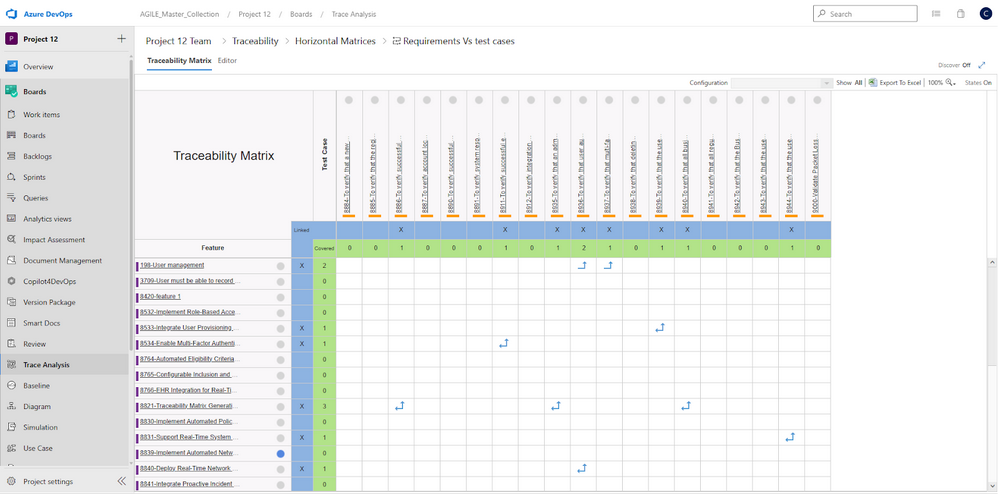
This type of analysis is generally performed using the requirements traceability matrix, which lists requirements on one axis and test cases with test results on the other, marking intersections where tests verify specific requirements.

In the matrix below, you can clearly see that gaps in this matrix reveal untested areas that pose risks.

Requirements Coverage Analysis

Other than that, requirements coverage analysis also tells you:

  • Which requirements have zero test coverage
  • Where you’re over-testing certain features
  • Whether high-priority specifications got proper validation
  • How confident can you be about shipping

In short, RCA helps teams ensure that the product meets all requirements and that they are properly validated.

Importance of Requirements Coverage Analysis

Here is why requirements coverage analysis is important in product testing:

  • Ensures comprehensive coverage: When requirements are not linked with any work item, task, or test cases, it is easy to miss during product delivery. However, requirements-based coverage analysis helps teams to ensure nothing is missed and each requirement is validated, tested, and delivered.
  • Handles requirements changes without chaos: Goodfirms has surveyed 150+ software development companies, and 53.8% of respondents said that they face challenges in adapting to changing requirements. However, coverage analysis can track what needs to be updated and prevent outdated validation. It can also guarantee that changed requirements are successfully tested and delivered.
  • Improves product quality: Of course, when the product meets all requirements, it can work perfectly under different conditions.
  • Reduces risks: When comprehensive coverage is ensured and all requirements are tested properly, it reduces the risk of missing requirements and bugs. This saves time and money.

Difference Between Requirements Coverage vs Test Coverage

Requirements coverage looks similar to the test coverage, but they both have significant differences, and we have covered a few differences here:

Aspect
Requirements Coverage
Test Coverage
What it measures
Checks if documented specifications have corresponding test cases
Evaluates whether all parts of the code are tested
Focus Area
Business needs and functional specifications
Code paths, branches, statements, and conditions
Primary Question
“Did we test what was asked for?”
“Did we run through all possible code scenarios?”
Tracking Method
Traceability matrix linking requirements to tests
Code analysis tools measuring execution paths
Stakeholder Interest
Product managers, business analysts, and clients
Developers, QA engineers, technical leads
Measurement Unit
Percentage of requirements validated
Percentage of code lines/branches executed
Risk It Addresses
Building wrong features or missing requested functionality
Bugs hiding in untested code segments
When It’s Applied
Throughout the requirement gathering and test planning phases
During and after test execution
Documentation Need
Requires clear, written specifications
Needs access to source code
Success Indicator
All critical business needs have validation
High percentage of code paths exercised

Steps to Performing Requirements Coverage Analysis

Requirements coverage analysis is a multi-step process, and here are some of the steps that teams should follow:

Step 1: Gather and Document All Requirements

The first step is to collect all requirements from different sources by using different requirements elicitation techniques and assign unique IDs to each requirement.

Step 2: Review and Clarify Ambiguous Requirements

Next, go through each requirement for improving vague requirements. Requirements must be clear enough that someone can write a test case against them. Flag anything that needs refinement before moving forward.

Step 3: Inventory Existing Test Cases

After that, create test cases for each requirement. You can include unit tests, integration tests, system tests, and acceptance tests. Give each test case a unique identifier similar to your requirements labeling system.

Step 4: Build the Traceability Matrix

Creating the traceability matrix is the main step in requirements coverage analysis. You can use:

  • Forward traceability to map requirements to test cases. This ensures every requirement is tested.
  • Backward traceability to map test cases to requirements. This shows how each test case is connected with requirements.
  • Or, Bidirectional traceability.

Instead of manually creating traceability matrices and managing them in spreadsheets, you can use requirements management tools like Modern Requirements4DevOps that directly work within Azure DevOps. With a single click, you can create horizontal and vertical traceability matrices and export them into an Excel file if required.

Step 5: Calculate Coverage Metrics

Now, you can use the formula below to calculate the coverage metrics:

(Number of requirements with at least one test / Total number of requirements) × 100

You can get values that are going to be used in a formula from the traceability matrix.

Or, you can use AI tools like Copilot4DevOps, which directly works within Azure DevOps and can provide you with a ready-to-use requirements coverage analysis report.

Step 6: Identify and Address Gaps

List requirements showing zero test coverage. Determine whether each gap needs new test cases or if the requirement itself has become obsolete. Prioritize gap-filling based on business impact and risk level.

Step 7: Maintain and Update Regularly

Requirements change, tests get added, and projects evolve. Schedule weekly or bi-weekly reviews to keep your matrix current. Outdated coverage data creates false security and missed defects.

This process can’t be managed in scattered documents. So, you need a specific tool for that. In the next section, we will see how Modern Requirements4DevOps can help with the same.

How Modern Requirements4DevOps Helps You Own Requirements Coverage

Modern Requirements4DevOps works as an extension on top of your Azure DevOps workspace. Here is how it helps in RCA:

Trace Analysis: You can create trace matrices and track coverage of requirements and test cases.

  • Impact Assessment: This feature helps teams to assess how a particular change will affect work items. So, they can update test cases accordingly.
  • Copilot4DevOps (AI assistant that comes with MR): The dynamic prompt and AI Chat feature of Copilot4DevOps can prepare requirements coverage reports within seconds.
  • Smart Report: Once comprehensive coverage of test cases is ensured using traceability matrices, teams can use the Smart report feature to prepare audit-ready reports.

Furthermore, MR4DevOps works best in safety-critical industries, such as aerospace, healthcare, banking, etc.

If you are struggling with requirements coverage analysis and looking for the best tool, start your 30-day free trial with Modern Requirements4DevOps.

Table of Contents

Start using Modern Requirements today

✅ Define, manage, and trace requirements within Azure DevOps
✅ Collaborate seamlessly across regulated teams
✅ Get started for FREE—no credit card required

Recent Articles